Showing posts with label Scion. Show all posts

Sunday, May 19, 2013

Scion FR-S Concept, 2011


  •  Scion FR-S Concept, 2011

Scion unveiled the rear-wheel drive FR-S Concept sports coupe at the 2011 New York International Auto Show. The Scion FR-S Concept will inspire a new model coming to the Scion brand in 2012.

The Scion FR-S Concept, which stands for Front-engine, Rear-wheel drive, Sport; is Scion's definition of an authentic rear-wheel-drive sports car with compelling style, exceptionally balanced performance and handling, flexible utility and surprising MPG.

The Scion FR-S is a true "scion," born into a lengthy history of Toyota performance cars and motorsports. The sports coupe is most inspired by the AE86 generation of the Corolla, better known as the Hachi-Roku, meaning "8-6" in Japanese. The front-engine, rear-wheel drive coupe was lightweight and well balanced, making it a solid choice for driving enthusiasts.

Inspired by the AE86, the FR-S is built around the core goal of achieving "pure balance," which begins with the strategic placement of a flat 2.0-liter boxer engine in a front-engine, rear-wheel drive configuration. The engine's compact size and shape allows the Scion FR-S' powertrain to be mounted lower and further back towards the rear, giving the car a lower center of gravity and a dynamically favorable front-to-rear weight ratio.

The Scion FR-S' naturally-aspirated engine is innovative, being the first boxer to incorporate Toyota's D4-S injection system, which utilizes both direct and port injection, resulting in increased horsepower and torque throughout the entire powerband, without sacrificing MPG.

The flat-four can mate with either a six-speed manual or a six-speed automatic transmission. The manual offers quick and precise shifts with a short-throw, while the automatic transmission features aggressive, sporty shifts that are initiated by steering-wheel-mounted paddle shifters. Power is distributed effectively via a limited-slip differential.

The idea of "pure balance" is further realized by the Scion FR-S Concept' lightweight design and short wheelbase. The combination allows the car to be quick and nimble into and out of any corner, with dynamic maneuverability and confident stability.

The fierce exterior of the Scion FR-S Concept is a good reflection of its inner power. The intimidating proportions of the concept give it a dominant stance that bleeds performance. The profile, inspired by the Toyota 2000GT, reveals a hood-line that is remarkably sleek and low, made possible by the boxer's architecture.

The low stance continues to exaggerate the FR-S' menacing face, which is made up of sharp lines, a wide mouth and angular headlights that include bright LED clusters.

The solid panel roofline is sleek, lightweight and rigid, slotted with an aerodynamic shape that channels air cleanly over to the top.

The front fenders protrude upward, making space for the massive monoblock Five Axis 20x8.5-inch wheels, while the muscular rear fenders are widened to house the 20x10.5-inch wheels, emphasizing the Scion FR-S Concept' staggered stance and rear-wheel-drive setup.

The rear fascia sits low and wide, with extensive lower treatments that surround the dual exhaust exits and contribute to excellent aerodynamics. LEDs illuminate both the edgy taillights and the bold "SCION" logo.

The concept features four-piston-caliper front brakes that clamp down on monstrous 18-inch annular carbon ceramic matrix rotors that are fixed to the wheels in a motorcycle-fashion.

The Scion FR-S Concept is layered in rich coats of Code Red, the appropriately named color that consists of a custom blend of candy and a developmental additive from BASF called Mearlite SSQ.

Scion FR-S Concept Dimensions
    Length: 168.2"
    Width: 71.5"
    Height: 47.4"
    Front Track: 61.8"
    Rear Track: 59.9"
    Wheelbase: 101.2"

Thursday, February 24, 2011

Scion tC Release Series 1.0, 2005

Scion tC Release Series 1.0, 2005


The Scion tC is a sports compact automobile introduced by Toyota in 2004 as a concept vehicle under its recently introduced Scion brand name. The Scion tC was designed to appeal to the Generation Y market and get them locked into the Toyota brand before any other car manufacturer could have a chance. They hoped to do so by making standard features numerous and optional features extremely easy to add.

The Scion tC uses the chassis of the Avensis which is sold in the European market, and the Camry's 2.4 L 2AZ-FE I4 engine. Its low price (base MSRP of US$16,715 for the 2006 model) is a major feature, as well as the pure pricing marketing style that Toyota has adopted.

The name tC does not fit in with its stablemates the xA and xB because the name xC has already been taken by Volvo for its XC70 and XC90 models. According to Scion, tC stands for "Touring Coupe."

Specifications
    * Engine: Double overhead cam (DOHC) 16-valve VVT-i 2.4 L 4-cylinder
    * Power: 160hp (119 kW) @ 5700 rpm
    * Torque: 163 ft·lbf (221 N·m) @ 4000 rpm
    * Transmission: 5-speed manual or available 4-speed electronically controlled automatic transmission
    * Highway fuel economy/consumption: 35-30 mi/U.S. gal (7.8 L/100 km) (automatic); 34-29 mi/U.S. gal (8.1 L/100 km) (manual)
    * City fuel economy/consumption: 29-23 mi/U.S. gal (10.7 L/100 km) (automatic); 28-22 mi/U.S. gal (10.7 L/100 km) (manual)
    * Fuel tank: 14.5 gal (54.9 L)
    * Brakes: 4-wheel anti-lock braking system employing disc brakes on both the front and rear
    * Curb weight: 2,970 lb (1,347 kg) (automatic); 2,905 lb (1,318 kg) (manual)
    * Displacement: 2382 CC

Scion t2B Concept, 2005

Scion t2B Concept, 2005


The t2B is a concept car from Scion, designed by Calty Design (Toyota's design studio in California) and built by Five Axis Models in Huntington Beach, California. It debuted at the 2005 New York Auto Show. Its name stands for Tall 2 Box. It appears rather like a mini-van, with 2 rows of bench seats, although the exterior is similar to the xB. On the passenger side there is 1 automatic sliding door. The driver side has doors that open 180 degrees, the rear door being a suicide door. The idea of the t2B is to be a social and entertainment enigma to the occupants.

Scion 5 Axis Widebody DJ xB, 2005

Scion 5 Axis Widebody DJ xB, 2005


The Scion xB is the American-market name given to the subcompact Toyota bB. It is a small wagon based on the Toyota Yaris platform. The xB was one of two models in the lineup of Toyota's US-exclusive Scion division present at the brand's 2004 launch (the other was the xA, based on the Toyota ist). Both cars feature the 1NZ-FE engine, rated at 108 hp (81 kW) at 6000 rpm and 105 lb-ft of torque at 4200 rpm.

The Toyota bB was an established model in Japan before the Scion xB version was introduced to the US.

Scion Marketing

The Scion xB's marketing is aimed at Generation Y, Americans born in 1978 or later. This group of car buyers is extremely important to manufacturers due to their large numbers (78 million) and their differing perceptions and demands of the vehicles they drive.

Although Toyota expected the xA to sell better than the xB, the reverse proved to be true, with the xB outselling its brother 2 to 1, possibly due to the xB's distinctive styling, and the xB's unique combination of van-like cargo and passenger space with a very compact size.

Differences between the xB and the bB

Besides the obvious change from right to left-hand drive, the front passenger area has changed significantly. The bB has a front bench seat and a column-mounted shifter for the automatic transmission. The xB, on the other hand, has 2 front bucket seats and a shifter mounted on the floor.

The available drivetrains also differ. The bB is available with either the 1.3 L 2NZ-FE engine or the 1.5 L 1NZ-FE, mated exclusively to a 4-speed automatic transmission with available all-wheel drive. The xB is only available with the 1NZ-FE, but offers both a 4-speed automatic or a 5-speed manual transmission. All-wheel drive is not offered on the xB.

The Toyota bB does not have a spare tire. On the Scion xB, a compact spare tire is stored under the left side of the rear cargo floor. Since the spare tire raised the cargo floor by several inches, a storage compartment was added to the right of the spare tire to reclaim some of the lost storage space. A jack is stored under the driver's seat of the xB.

Tuesday, November 16, 2010

Scion Hako Coupe Concept, 2008

Scion Hako Coupe Concept, 2008
<Click thumbnails to enlarge>


The Scion's Hako Coupe Concept embodies a distinct global perspective on today's youth. This type of forward thinking complements the Scion philosophy of intently listening to our customers and being willing to take risks to help us see where our brand should be. We took the xB's iconic boxy shape and explored something more vivacious, yet just as emotionally appealing. This concept is the sporty version of a box."

Tokyo Design developed the Scion Hako Coupe with classic American coupes in mind. The car's geometric profile conveys a powerful stance in a compact and bold package. Its trapezoidal LED headlights lie parallel with a large and aggressive, rectangular upper grille. The lower rectangular grille anchors the front fascia and continues to communicate the Hako's aggressive attitude. Round fog lights, symmetrically placed high on the front bumper, have integrated turn signals.

The Hako's silhouette is accentuated by slim, race-car-inspired side mirrors that also feature integrated turn signals. Powerful, flared fenders add dimension and contrast to the concept's boxy shape and smooth surface planes. The Hako concept hugs the road with custom 18-inch deep dish five-spoke wheels and tires with a "Scion" custom tread.

The Scion Hako Coupe features a vertical windshield as the concept sits upright and ready to attack the road. A high linear beltline along with a blackened and chopped greenhouse seamlessly wrap around the rear to provide a mysterious profile. As an example of potential personalization, the concept is equipped with a flat, panorama roof that features a random, barcode-like pattern that can be seen on the exterior and from the interior.

The rear features LED taillights that echo the shape of the headlights. To complete the package, the rear bumper has an integrated fog and back up light on the left and exhaust on the right.

The inside, 
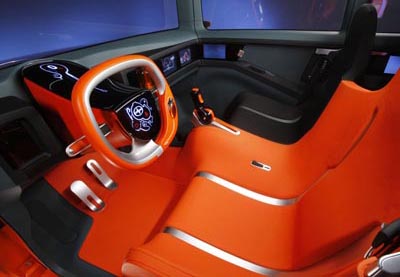
the Hako is accented with orange and metallic detailing that exudes a modern environment with entertainment possibilities. The front and rear seats are covered with urethane and rubber-like upholstery for easy cleaning. The contemporary front bucket seats flow to the floor and incorporate a geometric design on the seatback. The seats are separated by a center console that features a large storage crevice for storing magazines, cell phones, and other small items. Two cockpit-like rear seats also share a storage crevice.

The orange driver's seat has a gaming theme. Instrumentation and warning lights cascade from the art inspired instrument panel to the steering wheel. The shifter, located on the center console, resembles a large joystick. On the steering wheel is a simple button to start the engine and a track-ball type control for the Hako's entertainment system located on the passenger dash. The entertainment system consists of two video monitor screens mounted on the dash for radio, video, and music capabilities.

The video monitors located on each door and on each side of the rear seating area project distorted fish-eye images from orange filtered cameras mounted beneath the A-pillars. While the vehicle is parked the driver and passenger can edit the scenes captured by the cameras to show their friends where they have been and perhaps even post the clip online for others to see.
Related Posts Plugin for WordPress, Blogger...