Showing posts with label Chevrolet. Show all posts

Thursday, June 6, 2013

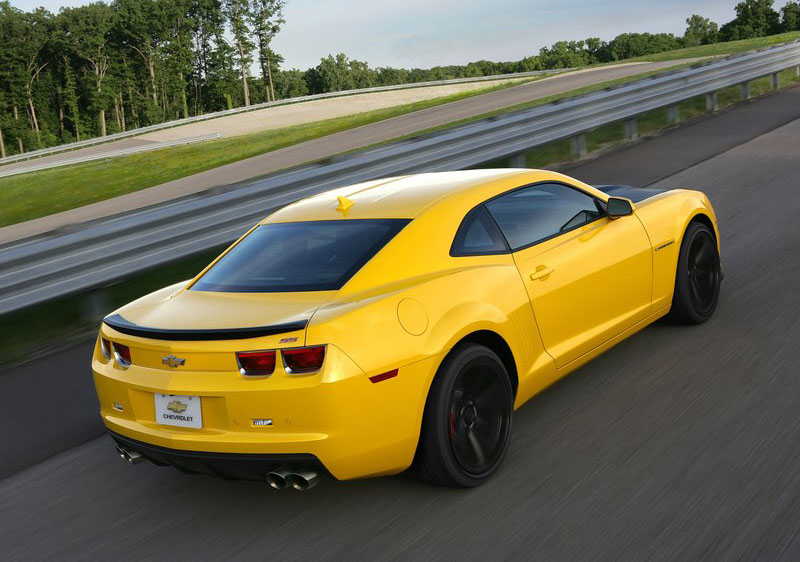
Chevrolet Camaro 1LE, 2013


  •  Chevrolet Camaro 1LE, 2013

The road-racing-inspired Chevrolet Camaro 1LE performance package returns for 2013 with unique gearing, suspension tuning and tires that make the model capable of more than 1 g of lateral acceleration and a sub-three minute lap time at Virginia International Raceway's Grand Course. It is offered on Camaro SS coupes with manual transmissions.

The 1LE package is offered on 1SS and 2SS coupe models with an exclusive Tremec TR6060-MM6 six-speed manual transmission. Paired with a numerically higher 3.91 final-drive ratio, the close-ratio gearing of the transmission is tuned for road-racing performance. As with the ZL1, the 1LE transmission features a standard air-to-liquid cooling system for track use.

The Chevrolet Camaro 1LE also features exclusive, monotube rear dampers instead of the twin-tube dampers on SS models. The new hardware allowed engineers to tune the 1LE suspension to focus on optimal body-motion control while preserving much of the ride quality and wheel-motion control of the Camaro SS.

Other changes to optimize the 1LE for track-day use:
  • Larger, 27-mm solid front stabilizer bar, and 28-mm solid rear stabilizer bar for improved body control
  • Higher-capacity rear-axle half shafts to cope with increased levels of traction
  • Strut tower brace for improved steering feel and response
  • ZL1-based 20 x 10-inch front and 20 x 10-inch aluminum wheels
  • 285/35ZR20 Goodyear Eagle Supercar G:2 tires front and rear (identical to the front tires for ZL1)
  • ZL1 wheel bearings, toe links and rear shock mounts for improved on-track performance
  • ZL1 high-capacity fuel pump and additional fuel pickups for improved fuel delivery during high-load cornering.

Visually, the 1LE package is distinguished by its matte black hood, front splitter and rear spoiler - as well as the 10-spoke ZL1-based wheels, which are finished in black. The functional front splitter and rear spoiler contribute to the car's on-track performance by helping to reduce aerodynamic lift at high speeds.

Inside, the Chevrolet Camaro 1LE package incorporates the ZL1's flat-bottom steering wheel, trimmed in sueded-microfiber and designed for easier heel-and-toe driving on the racetrack. The quick-acting, short-throw shifter from the ZL1 is also trimmed in sueded-microfiber.

In anticipation of consumers entering the 1LE in amateur-racing events, Chevrolet is pursuing SCCA approval of the 1LE package for Touring Class competition.

The first Chevrolet Camaro 1LE package was introduced in 1988, inspired by Camaro's involvement in Pro-Am road racing.

Thursday, April 11, 2013

Chevrolet Camaro Hot Wheels Edition, 2013


  •  Chevrolet Camaro Hot Wheels Edition, 2013

The dream of millions of Hot Wheels® fans of all ages will come when the Camaro Hot Wheels® Edition arrives at Chevrolet dealerships in early 2013. It's the first time a full-size, production Hot Wheels® car has been offered for sale by any manufacturer.

Blister packaging and orange race track not included.
"Millions of us grew up playing with Hot Wheels," said Chris Perry, vice president of Chevrolet Marketing. "Offering a special production model of the Camaro Hot Wheels is an opportunity to bring those memories to life, for kids of all ages."

The Chevrolet Camaro Hot Wheels® Edition debuted at the 2012 SEMA Show, in Las Vegas. A special run of the Camaro Hot Wheels® Edition will be produced in the first quarter of 2013 - and like the collectable toys on which it is based - when they're gone, they're gone.

"It's been nearly 20 years since I started designing cars for Hot Wheels and I have yet to drive one home," said Felix Holst, vice president of creative for the Mattel Wheels Division. "Personally, I can't wait to open the doors and see the Hot Wheels Camaro sitting in the garage."

The appearance of the Chevy Camaro Hot Wheels® Edition echoes the cues that Hot Wheels enthusiasts recognize, including a vibrant, graphics-accented metallic paint scheme and even the red-lined wheels. The result is instantly recognizable as a Hot Wheels.

The Chevrolet Camaro Hot Wheels® Edition is available in coupe and convertible models - in 2LT (V-6) and 2SS (V-8) trims, blending exterior cues of the high-performance Camaro ZL1 with a Kinetic Blue exterior color and unique graphics. Exterior highlights:
  •     ZL1 rear spoiler (coupe models)
  •     ZL1 front upper grille
  •     Ground effects package, including front splitter and rocker treatment
  •     Black 21-inch wheels with red outline stripe
  •     Two-tone matte hood graphic and rear taillight panel "blackout" graphic
  •     Fender "flame" graphics
  •     Hot Wheels grille and decklid logos.

On the inside, a black leather-trimmed interior is accented with red and black seat stitching with the Hot Wheels logo embroidered on the front seats. The instrument panel and door inserts are black, with the Hot Wheels-style flame decal on each door. Hot Wheels® Edition sill plates also distinguish the car, along with Camaro-logo premium floor mats with red edging.

SS models feature a 6.2L V-8, which is offered in two iterations: the "L99" on automatic-equipped vehicles and the "LS3" on manual-equipped models. Horsepower for the L99 is 400 (298 kW) and torque is 410 lb.-ft. (556 Nm) - and it features fuel-saving Active Fuel Management. The LS3 develops 426 horsepower (318 kW) and 420 lb.-ft. (569 Nm) of torque.

LT-based models feature the "LFX" 3.6L V-6 engine, with dual-overhead camshafts, variable valve timing and direct injection. It's rated at 323 horsepower at 6,800 rpm.

A dual-mode exhaust system is available on SS models with the six-speed manual transmission, as well as LT models with either the manual or automatic transmission. Similar to the systems found on the Camaro ZL1, the vacuum-actuated system provides a quieter driving experience at low engine speeds and a more aggressive sound during hard acceleration.

Chevrolet's MyLink infotainment system is standard on the Chevy Camaro Hot Wheels® Edition. Its color touch radio, with a seven-inch touch screen, also can be paired with an available in-dash GPS navigation system. The color touch radio with MyLink enables a higher level of in-vehicle wireless connectivity and customized infotainment options, while building on the safety and security of OnStar. It seamlessly integrates online services such as Pandora® internet radio and Stitcher SmartRadio® using hands-free voice and touch-screen controls via Bluetooth-enabled phones.

Monday, December 24, 2012

Chevrolet Corvette GT1, 2009


  • Chevrolet Corvette GT1, 2009

The Chevrolet introduced the limited production Corvette GT1 Championship Edition.
Championship Edition (Regular Production Option GT1) commemorates the success of Corvette Racing and the Corvette C6.R:
    * Eight American Le Mans Series GT1 manufacturers and team championships
    * Five-time 24 Hours of Le Mans class champions
    * 74 victories in international sports car competition

GT1 Championship Edition package:
    * Graphics inspired by C6.R livery feature Corvette Racing
    * ZR1-style body color full-width spoiler and chrome wheels
    * Custom leather-wrapped ebony interior with exclusive yellow accent stitching
    * GT1 embroidery on leather seats, instrument panel, and center console armrest
    * Special engine cover with carbon pattern and yellow Corvette lettering
    * Windshield banner (owner installed)


Monday, January 23, 2012

Chevrolet Corvette C3, 1968


Chevrolet Corvette C3, 1968

The Chevrolet Corvette C3 is a sports car patterned after Chevrolet's "Mako Shark" (designed by Larry Shinoda), produced between 1968 and 1982. It is the third generation of Chevrolet Corvettes built and marketed by Chevrolet.

The generation has the distinction of being introduced to the motoring public in an unorthodox — and unintended — fashion. 1968 marked the introduction of Mattel's now-famous Hot Wheels line of 1/64-scale die cast toy cars. General Motors had tried their best to keep the appearance of the upcoming car a secret, but the release of the Hot Wheels line several weeks before the Corvette's unveiling had a certain version of particular interest to Corvette fans: the "Custom Corvette", a GM-authorized model of the 1968 Corvette.

In 1969, GM enlarged their small-block again to 350 in³ (5.7 L), and in 1970 the 427 big-block was enlarged to 454 in³ (7.4 L). Power peaked in the 1970 and 1971 models, with the 1970 LT-1 small-block putting out 370 hp (276 kW) and the 1971 454 big-block having its last year of big power with 425 hp (317 kW). In 1972, GM moved to the SAE Net measurement for power (away from the previous SAE Gross standard), which resulted in lower values expressed in hp. Along with the move to unleaded fuel, emission controls, and catalytic converters, power continued to decline and bottomed out in 1975 — the base ZQ3 engine put out 165 hp (123 kW), and the optional L82 engine put out 205 hp (153 kW). Power remained fairly steady for the rest of the C3 generation, ending in 1982 with the 200 hp (149 kW) L83 engine.

Styling changed subtly over the generation. In 1973, the Corvette dropped the front chrome bumpers for a urethane-compound "5 mph" bumper but kept the rear chrome bumpers. In 1974, The rear chrome bumpers became urethane, too, making 1973 the last Corvette model year with any chrome bumpers. 1975 was the last year for the convertible, and 1978 saw the introduction of a glass bubble rear window. In 1980, the Corvette got an integrated aerodynamic redesign that resulted in a significant reduction in drag.

Chevrolet Camaro, 1967

 Chevrolet Camaro, 1967

The Chevrolet Camaro was introduced in North America by the Chevrolet Motor Division of General Motors at the start of the 1967 model year as competition for the Ford Mustang. Camaro advertising would first be found on AM top-40 stations of the day - stations which appealed to young adults. Although it was technically a compact car (by the standards of the time), the Camaro, like the entire class of Mustang competitors, was soon known as a pony car. It may also be classified as an intermediate touring car, a sports car, or a muscle car. The car shared the same platform and major components with the Pontiac Firebird, also introduced in 1967. Production of both cars ceased in 2002 with only the Camaro going back into production in 2009.

The Camaro was the flagship for Chevrolet, and was for many years one of its most popular models. If its frequent inclusion in automotive enthusiast magazines is any indication, the Chevy Camaro is one of the most popular cars for modification in automotive history.

Sharing some mechanicals with the upcoming 1968 Chevrolet Nova, the Camaro featured a unibody structure, combined with a sub-frame supporting the front end. Chevrolet offered the car in only two body styles, a coupe and convertible. Almost 80 factory and 40 dealer options including three main packages were available.
Chevrolet Camaro

The RS included many cosmetic changes such as RS badging, hidden headlights, revised taillights, and exterior rocker trim.

The SS included a modified 5.7L (350) V8 engine (first engine of that size by Chevrolet), and the L35 396(6.5L) big-block V8 was also available. The SS featured non-functional air inlets on the hood, special striping and SS badging on the grille, gas cap, and horn button. It was possible to order both the SS and RS to receive a Camaro SS/RS. In 1967, a Camaro SS/RSS convertible with a 396(6.5L) engine paced the Indianapolis 500 race.

The 'Z/28' option code was introduced in December 1966 for the 1967 model year. This option package wasn't mentioned in any sales literature, so it was unknown to most buyers. The only way to order the Z/28 was to order a base Camaro with the Z28 option, front disc brakes, power steering and a Muncie 4-speed manual transmission. The Z/28 featured a unique 302(4.9L) small-block engine, designed specifically to race in the Trans Am racing series (which required engines smaller than 305(5.0L) and public availability of the car. Advertised power of this engine was listed at 290hp (216kW) while actual dynometer readings rated it at 360 to 400hp (269 to 298kW). The Z/28 also came with upgraded suspension and racing stripes on the hood. It was possible to combine the Z/28 package with the RS package. Only 602 Z/28s were sold in 1967. Contrary to popular belief, 1967 Z/28s did not have raised cowl induction hoods like 1969 Z/28s did. In 1967, the 1967 Z28 received air from a cowl plenum duct attached to the side of the air cleaner that ran to the firewall and got air from the cowl vents. The hood was a standard flat hood. 1967 Z/28s had 15 in. Rally wheels, while all other 1967 Camaros had 14 in. wheels. The Z/28 could be combined with the RS appearance package.

The Camaro's standard drivetrain was a 3.8L (230kW) Straight-6 engine rated at 140hp (104kW) and backed by a Saginaw three-speed manual transmission. A Muncie four-speed manual was also available. The two-speed "Powerglide" automatic transmission was a popular option in 1967 and 1968 until the three-speed "Turbo Hydra-Matic 350" replaced it starting in 1969. The TH350 was also an option on SS396 cars from late 1967 onwards.

The 290hp (216kW), 5.7L (350) V8 first saw duty in the 1967 Camaro and virtually every engine in the Chevrolet lineup was offered as an option.

Production numbers:
  •  RS: 64,842
  •  SS: 34,411
  •  Z28: 602
  •  Total: 220,906

Chevrolet Impala Super Sport, 1966

 
Chevrolet Impala Super Sport, 1966

The Impala was introduced in 1958 as a new up-level, sporty trim package created for Bel Air coupes and convertibles. Unique to the model were its six taillights, which set it apart from lower trim levels with only two lights on a side. This classic styling cue would become its trademark. It was named for a southern African antelope. The Impala became a separate model in 1959 in both two and four-door versions and became the best selling car in the Chevy product line.
For 1960, it became the best-selling automobile in the United States and held that position for the next decade. From 1958 until 1996, Impala sales were in excess of 13 million units, more than any other full-size car in the history of the automobile. In 1965, the Impala set an all-time industry annual sales record of more than 1 million units, which has never been bettered.

In 1965, Chevrolet introduced the Impala Caprice. Beginning with the four-door hardtop sedan body, Impala Caprices received unique upholstery, wood grained accents on the dash board and specialty pulls on the insides of the doors. A one year model, the Impala Caprice was reintroduced as the Chevrolet Caprice in 1966, taking the top position in the Chevrolet lineup. The Impala however, remained Chevrolet's top-selling model until late 1970s. During the 1969 model year, for example, Impala production topped Caprice production by 611,000 units.

The 1971 redesign introduced the largest Impala. The Impala's chassis would not be this extensively changed again until the introduction of the 2000 Impala. The Impala would remain Chevrolet's best-selling model until 1977.

The Impala is often credited with starting the muscle car era, although the credit for that really goes to Pontiac when it released the GTO. In the 1960s, gasoline was cheap and consumer demand for power exceeded the need for efficiency. Buyers were clamoring for as much room, performance, amenities and quality as they could get for their dollars. Afraid it would lose out to an in house competition, Chevy released its muscle car, the SS, soon after. In 1961, the Impala SS (Super Sport) was introduced to the market. The SS badge was to become Chevrolet's signature of performance on many models, though it has often been an appearance package only. The Impala's SS package in 1961 was truly a performance package, beginning with the high-performance 348 in³ (5.7 L) engines (available with 305, 340, and 350 hp (230, 255 and 260 kW)) or the new 409 in³ (6.7 L), which was available with up to 425 hp. The package also inclued upgraded tires on station wagon wheels, springs, shocks and special sintered metallic brake linings. Starting in 1962, the Impala SS could be had with any engine available in the Impala, right down to the 235 in³ 135 hp inline-6. With one exception, from this point until 1969, the SS was an appearance package only, though the heavy-duty parts and big engines could still be ordered.

The exception was the Z24 option package available in combination with the standard Z03 Super Sport package. Starting in 1967, through 1969, buyers of Z24s Impalas got cars badged as "SS427" models. The SS427 included heavy duty suspension and other performance goodies, as well as a Turbo-Jet 427 in either L36 or L72 variations. Special SS427 badging inside and out were the rule, but few were sold, since "muscle car" enthusiasts were looking toward big-block intermediates like the Chevelle SS396 and Plymouth Hemi Roadrunners, which were lighter and subsequently faster off the line. Interestingly, Z24 cars could be ordered without the Z03 SS package, which meant SS427 equipment but no bucket seats or center console.

The Impala SS could be identified by SS emblems on the rear fenders and trunk lid. The Impala SS became its own series (separate model rather than an option package) for 1964. In 1968, the Impala SS once more became an option package rather than having its own model. In 1969, the Impala SS was only available as the Z24 (SS427), coming only with a 427 in³V8 of 390 or 425 hp. This was the final year for the Impala SS until 1994.

Wednesday, February 16, 2011

Chevrolet Corvette C2, 1963

Chevrolet Corvette C2, 1963


The Chevrolet Corvette C2 is a sports car designed by Larry Shinoda under the styling direction of Bill Mitchell, and produced between 1963 and 1967. It is the second generation or mid-year Chevrolet Corvette built and marketed by Chevrolet.

1963 would see the introduction of the new Corvette Sting Ray coupé with its distinctive split rear window and fake hood vents as well as an independent rear suspension. The split rear window was discontinued in 1964 due to safety concerns. Because they made the design too busy, the hood vents were also cut. Power for 1963 was at 365 hp (272 kW) hitting 375 hp (280 kW) in 1964.

4-wheel disc brakes were introduced in 1965, as was a "big-block" engine option (the 396 in³ (6.5 L) V8). Side exhaust pipes appeared on the 1965 Stingray and persisted through 1969. Chevrolet would up the ante in 1966 with the introduction of an even larger 427 in³ (7 L) version, creating what would be one of the most collectible Corvettes ever. 1967 saw a L88 version of the 427 introduced which was rated at 430 hp (321 kW), but unofficial estimates place the actual output at 550 hp (410 kW) or more. Only twenty such engines were placed in the 1967 Corvette, and the cars can fetch US$600,000 or more in auction today. From 1967-1969, the 1282 cfm Holley triple two-barrel carbuetor, or Tri-Power, was available on the 427. The 1967 Corvette originally was going to be the first of the C3 generation; however, due to delays the C3 had to be put off until 1968. Other early options available on the C2 included AM-FM radio (mid 1963), air conditioning (1963), telescopic wheel (1965), head rests, presumably to prevent whiplash (1966).

The 1965 introduction of the 425HP 396 c.i. big block was ultimately the harbinger of doom for the Rochester Fuel injection system. The 396 425HP option cost $145. The 327-370HP Fuelie option cost $500. Few people could justify spending $355 more, for 55 hp less. When less than a thousand fuelie cars were built in 1965, Chevy stopped the program. It was indeed short sighted. Chevy was way ahead of its time and had they continued every car that says Lucas or Bosch Fuel injection now, may have said Rochester. As of this writing GM does not make any carburated cars.

In 2004, Sports Car International named the Stingray number five on the list of Top Sports Cars of the 1960s.
The design of this generation had several inspirations. The first was the contemporary Jaguar E-Type, of which Mitchell owned one and enjoyed driving it frequently. Bill Mitchell also sponsored a car known as the "Mitchell Sting Ray" in 1959, because Chevrolet no longer participated in factory racing. This vehicle had the largest impact on the styling of this generation, although it had no top and didn't give away what the coupe would look like. The third inspiration was a mako shark that Mitchell caught while deep-sea fishing.

Chevrolet Corvette Mako Shark Concept, 1961

Chevrolet Corvette Mako Shark Concept, 1961


The XP-755 Mako Shark show car was designed by Larry Shinoda under the direction of GM Design head Bill Mitchell in 1961, as a concept for future Chevrolet Corvettes. In keeping with the name, the streamlining, pointed snout, and other detailing was partly inspired by the look of that very fast fish. The "Mako Shark" was very similar to the 1963 Corvette, with some alterations. These included adding two more brake lights in the rear (six total), making the nose of the car longer and more pointed, creating a clear glass roof with a periscope-like rear-view mirror, and remodeling the interior.

A widespread story has it that Mitchell had an actual shortfin mako shark mounted on the wall in his office, and ordered his team to paint the car to match the distinctive blue-gray upper surface gently blending into white underside of the fish. After numerous attempts to match the fish's color scheme failed, the team hit upon the idea of kidnapping the fish one night, painting it to match their best efforts on the car, and returning it to the office. Mitchell never realized the difference and pronounced himself pleased with the team's duplication on the car of nature's handiwork.

Chevrolet Stingray Racer Concept, 1959

Chevrolet Stingray Racer Concept, 1959


Chevrolet Stingray Racer Concept, 1959

Tuesday, January 4, 2011

Chevrolet Nomad, 1957

Chevrolet Nomad, 1957


The Chevrolet Nomad was a station wagon produced by the Chevrolet Motor Division of the General Motors Corporation from 1955 to 1961. The Nomad is best remembered as a two-door station wagon and is commonly associated with the "surf culture" of the late 1950s and early 1960s. The Nomad was considered Chevrolet's halo model during its three-year production as a two-door station wagon.

1955-1957
The two-door Nomad differed from other station wagons of the era by having unique styling more reminiscent of a hardtop than of a standard station wagon. Chevrolet shared this body with its sister Pontiac, which marketed their version as the Pontiac Safari.

The Nomad's unique design had its roots in a General Motors Motorama show car of the same name that was based on the Corvette. GM approved production of the vehicle if the design could be transferred to its full-size models, because top GM brass felt that they could sell more models if it were attached to the popular Bel Air model.

While considered to be a milestone vehicle design, General Motors discontinued the original Nomad at the end of the 1957 model year to focus attention on its upcoming new halo vehicles like the Chevrolet Impala.

Chevrolet Nomad, 1954

Chevrolet Nomad, 1954


The Chevrolet Nomad was a station wagon produced by the Chevrolet Motor Division of the General Motors Corporation from 1955 to 1961. The Nomad is best remembered as a two-door station wagon and is commonly associated with the "surf culture" of the late 1950s and early 1960s. The Nomad was considered Chevrolet's halo model during its three-year production as a two-door station wagon.

1955-1957
The two-door Nomad differed from other station wagons of the era by having unique styling more reminiscent of a hardtop than of a standard station wagon. Chevrolet shared this body with its sister Pontiac, which marketed their version as the Pontiac Safari.

The Nomad's unique design had its roots in a General Motors Motorama show car of the same name that was based on the Corvette. GM approved production of the vehicle if the design could be transferred to its full-size models, because top GM brass felt that they could sell more models if it were attached to the popular Bel Air model.
While considered to be a milestone vehicle design, General Motors discontinued the original Nomad at the end of the 1957 model year to focus attention on its upcoming new halo vehicles like the Chevrolet Impala.

1958-1961
For the 1958 model year, Chevrolet applied the Nomad name to its traditional top-line four-door station wagon.

In 1959, the Nomad was transferred to the expanded Impala model range, which had replaced the Bel Air as the top-line Chevrolet. Chevrolet continued to use the Nomad name until the end of the 1961 model year, when all Chevrolet station wagons adopted their parent model name.

1964 through 1980's
The Nomad returned again in 1964 and 1965 as a two-door Chevelle station wagon, and spent the rest of the 1960's as a low-level Chevelle station wagon. In the 1970's and early-1980's it was even offered as a G-Series full-size van model.

Chevrolet Corvette C1, 1953

Chevrolet Corvette C1, 1953


The Chevrolet Corvette C1 is a sporty automobile produced from 1953 through 1962. It is the first generation of Chevrolet Corvettes built and marketed by Chevrolet.

Design
While the style of a car may be just as important to some as to how well the car runs, automobile manufacturers did not begin to pay attention to car designs until the 1920s. It was not until 1927, when General Motors hired designer Harley Earl, that automotive styling and design became important to American automobile manufacturers. What Henry Ford did for automobile manufacturing principles, Harley Earl did for car design. Most of GM's flamboyant "dream car" designs of the 1950s are directly attributable to Earl, leading one journalist to comment that the designs were "the American psyche made visible." Harley Earl loved sports cars, and GIs returning after serving overseas World War II were bringing home MGs, Jaguars, Alfa Romeos and the like. Earl convinced GM that they needed to build a two-seat sports car. The result was the 1953 Corvette, unveiled to the public at that year's Motorama car show. The original Corvette emblem incorporated an American flag into the design; this was later dropped, since associating the flag with a product was frowned upon.

Taking its name from the corvette, a small, maneuverable fighting frigate (the credit for the naming goes to Myron Scott), the first Corvettes were virtually handbuilt in Flint, Michigan in Chevrolet's Customer Delivery Center, now an academic building at Kettering University. The outer body was made out of a revolutionary new composite material called fiberglass, selected in part because of steel quotas left over from the war. Underneath that radical new body were standard Chevrolet components, including the "Blue Flame" inline six-cylinder truck engine, two-speed Powerglide automatic transmission, and drum brakes from Chevrolet's regular car line. Though the engine's output was increased somewhat, thanks to a triple-carburetor intake exclusive to the Corvette, performance of the car was decidedly lackluster. Compared to the British and Italian sports cars of the day, the Corvette was underpowered, required a great deal of effort as well as clear roadway to bring to a stop, and even lacked a "proper" manual transmission. Up until that time, the Chevrolet division was GM's entry-level marque, known for excellent but no-nonsense cars. Nowhere was that more evident than in the Corvette. A Paxton supercharger became available in 1954 as a dealer-installed option, greatly improving the Corvette's straight-line performance, but sales continued to decline.
Chevrolet Corvette C1

GM was seriously considering shelving the project, leaving the Corvette to be little more than a footnote in automotive history, and would have done so if not for two important events. The first was the introduction in 1955 of Chevrolet's first V8 engine (a 265 in³ {4.3 L}) since 1919, and the second was the influence of a Soviet emigre in GM's engineering department, Zora Arkus-Duntov. Arkus-Duntov simply took the new V8 and backed it with a three-speed manual transmission. That modification, probably the single most important in the car's history, helped turn the Corvette from a two-seat curiosity into a genuine performer. It also earned Arkus-Duntov the rather inaccurate nickname "Father of the Corvette".

The first generation is commonly referred to as a solid-axle, based on the fact that independent rear suspension (IRS) was not available until 1963.

Fuel injection
The first generation started in 1953 and ended in 1962, with the noteworthy addition of optional fuel injection in 1957. This new induction system first saw regular use on a gasoline engine two years prior on the Mercedes-Benz 300SL "Gullwing" roadster. Although the Corvette's GM-Rochester fuel injection system used a constant flow style fuel injection system as opposed to the diesel style nozzle metering system of the Mercedes' six cylinders, the system nevertheless produced about 290HP. The number was derated by Chevrolet's advertising agency for the 283HP/283 in³ (4.6 L) one hp per in³ slogan, making it one of the first mass-produced engines in history to reach 1 hp/in³. In 1962, the GM Small-Block was enlarged to 327 in³ (5.4 L) and produced a maximum of 360 hp (268 kW). Other early options included Power windows (1956), hydraulically operated power convertible top (1956), four speed manual transmission (mid 1957), and heavy duty brake and suspension options (1957).

Chevrolet Truck Classic V-8, 1949

Chevrolet Truck Classic V-8, 1949


Chevrolet Truck Classic V-8, 1949

Chevrolet Pick-Up, 1949

Chevrolet Pick-Up, 1949


Chevrolet Pick-Up, 1949
Related Posts Plugin for WordPress, Blogger...