Showing posts with label 2006. Show all posts

Tuesday, May 7, 2013

Noble M15, 2006


  •  Noble M15, 2006

Building on the success of the no-compromise M12, the M15 is a more mature Noble with luxuries including Satellite Navigation, impeccable ride and 300 litres of luggage space!

With a 455bhp version of the tried and trusted three-litre twin turbo engine Noble has come to rely on, this is also the quickest car ever to emerge from Barwell, Leicestershire. With the complementary figure of 455lb/ft of torque, all in a car that weighs slightly more than 1200kg, the M15 is devastatingly fast.

The M15 accelerates from 0-60mph in less than 3.5 seconds and 10 100mph in less than 8s. It keeps going all the way to 185mph, too, and has been tuned for rapid acceleration throughout the range rather than an easily achievable 200mph top end speed.

Supreme cornering skills and a confidence-inspiring chassis are part the DNA and, in this respect, the M15 promises to be the best yet. The spaceframe chassis with integral rollcage is 57 per cent stiffer than the M12 that has won plaudits throughout the world and intensive development has ensured that the fabled Noble handling on the limit is even better than before.

At £74,950 the M15 pitches straight into battle with the established supercar brands, but Noble is happy to meet them head on. "Hopefully people that test this car will see it as a real alternative to £130,000 exotica, as well as the immediate competition in the price range," he said. "We know we're taking on tough opposition, but I'm sure this car is going to take us forward in a big way."

Tuesday, January 8, 2013

EDAG Biwak Concept, 2006


  • EDAG Biwak Concept, 2006

For the new EDAG concept car, the classic, half-rounded beetle shape has been converted into an estate silhouette, creating extra room for various new professional and leisure applications. As well as offering the advantages of a marked increase in storage space and greater headroom for the back seat passengers, the the SUV light concept also provides more ground clearance, to enable the driver to take the vehicle off the road or race track. Practical and stylish: the rear door provides easy access to the luggage section. The new body design drawn up by the EDAG stylists and developed by the EDAG engineers has the potential for use in vehicles for volume production. The EDAG Biwak would be the ideal second car for a family, though it could just as easily prove popular as a stylish leisure vehicle for surfers or divers, or even do service as a delivery truck for crafts or tradesmen. The concept combines a multitude of requirements, making it attractive to a broad spectrum of customers. To demonstrate the industrial feasibility of the concept, EDAG's development and production specialists have also worked out different manufacturing concepts for various quantities.

Trim + Colour as Marketing Instruments

Geneva Version: "Patina instead of High Gloss"
To increase its appeal to the intended target groups, the EDAG design team have created a sophisticated concept for individual equipment and features. Johannes Barckmann explains: "By utilising clearly worked out colour and trim concepts, we can adapt the look of the EDAG Biwak to appeal to the various target groups - high gloss finish and chrome elements for the bank clerk; crinkle finish, steel rims and denim for the young rebel. By offering numerous alternative versions of the extras, we can satisfy the customers' constant calls for individualisation."

With the version for the Geneva Show, EDAG deliberately set out to produce a provocative exterior - the EDAG Biwak look was inspired by the spirit of the grunge movement of the early 1990s, and takes up a successful trend in the fashion branch.
A matt crinkle finish on the ourtside combined with natural leather and denim on the inside create a direct counterpoint to the usual high-gloss look of other new cars.
The crinkle finish lends the EDAG Biwak a used look, which brings the direct utility value of the vehicle very much to the fore. "We are giving the customer the freedom to make full use of the vehicle, dispelling his or her worries about that first, inevitable scratch in the paintwork," is how Johannes accounts for the provocative trim colour concept.
In this case, the motto "patina instead of high gloss" is directed at a target group intent upon breaking with convention. Just one example of how colour and trim can be employed as marketing instruments.

Monday, December 17, 2012

BMW 7 Series High Security, 2006


  • BMW 7 Series High Security, 2006

The E65/E66 automobile platform is the basis for the 2002 through present BMW 7-series. It replaced the BMW E38 in 2002. E65 is the designation of the short wheel base version of the automobile, and E66 is the designation of the long wheel base version.

The arrival of this model heralded a new styling era for BMW, the work of chief designer Chris Bangle, with bold visual cues that did not premier on the scene without noted controversy from E38 community. The E65/E66 seems to be gaining favor after its colorful arrival, and it appears to be the gatekeeper for styling cues of future BMW models yet to come. The "Bangle-butt" rear styling has been especially controversial, and was toned down in a 2005 restyling.

The most important innovation contained in the 7 is also the most controversial one: the iDrive system. While able to manage a lot of functions -- on-board telematics, including GPS navigation, Internet access and the new BMW Assist system (for emergencies), as well as climate and stereo functions -- iDrive has a steep learning curve. Basic adjustments can be made rather easily.

Tuesday, December 11, 2012

Acura MD-X Concept, 2006


  • Acura MD-X Concept, 2006

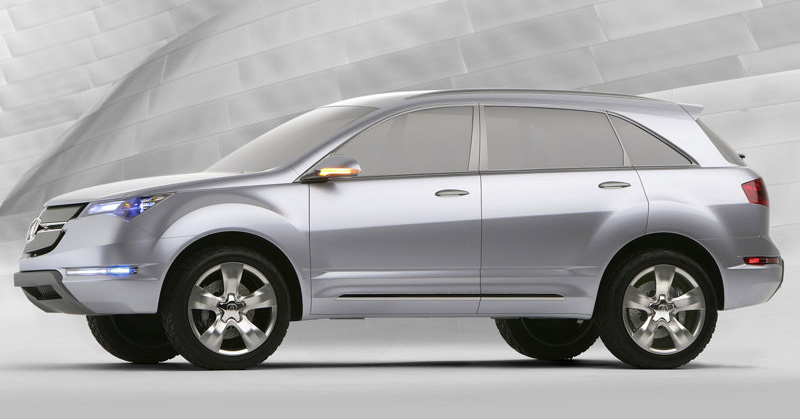
The Acura "MD-X Concept" luxury performance SUV made its world debut today at the 2006 New York International Auto Show featuring bold, sleek exterior styling indicative of the next generation MDX production model.

The MD-X Concept is fashioned as a true driver's SUV, with its low, wide stance and aggressive design. Its sleek surface lines are modeled after a high-powered megayacht.

The MD-X Concept features a wider track and longer wheelbase that give the vehicle a sportier, performance look. The profile of the concept reveals a refined SUV with smooth, chiseled lines and an elegant form. A dominant character line runs from the front quarter panel to the rear, evoking the feeling of forward movement. The sharply raked D-pillar creates a stealth, aerodynamic appearance while still retaining the third row seating functionality and cargo carrying capability of the current generation MDX.

The Concept sits low to the ground despite the large 20-inch five-spoke custom alloy wheels, while the large wheel arches and flares add to the Concept's muscular appearance. The sleek cabin features flush mounted windshield glass, which improves aerodynamics while adding to the MD-X Concept's smooth and flowing design.

The front hood is accented with pronounced character lines culminating in an aggressive five-sided grille, which gives the MD-X its bold presence. The commanding front grille features a dominant center bar running through a solid aluminum face. The narrow, Xenon High Intensity Discharge (HID) headlights appear to grow out of the massive grille, giving the overall front-end a strong, distinct look.

In the rear, the MD-X Concept has an integrated rear hatch, which sits flush against the bumper to create a smooth, clean appearance. LED taillights wrap around the cargo hatch adding to the vehicles wide and low appearance. A rear spoiler improves aerodynamics and the integrated dual exhaust pipes add to the SUV's sporty style.


Monday, December 3, 2012

Wiesmann Roadster, 2006


  • Wiesmann Roadster, 2006

The Wiesmann-Roadster which is manufactured since 1993, has been adapted permanently to the latest technical development. It's a dynamic and powerful sports car, made for convertible enthusiasts, taking its very own market position, supported by an ever growing fan community. The Wiesmann brand is established.

In succeeding years the Wiesmann-Roadster has been continuously developed and kept up-to-date with engineering progress. With almost 500 examples now having been built, a quality of finish has now been achieved which is unequalled among comparable small-scale manufacturers.

In 2003, on the 10th anniversary of the factory, Wiesmann gave the models a facelift: from the 300th. Roadster, all vehicles leaving the factory had a number of optical and technical detail alterations. The classic shape of the car body, which became very successful and is particularly loved by Wiesmann customers, retained unchanged. Improvements to the interior and modest alterations to the Roadster's external appearance were signs of the continued logical development of the vehicle concept.

Additional options allow the customers to individualise their own hand-made dream car. Individuality is the magic word! After all, the customer wants a car that is individually equipped, tailored to his wishes, crafted to suit him and make him satisfied and happy.

The Wiesmann-Roadster is available with two powerful engines:
MF 30 - 170 kW/231 HP - 2,979 cc
MF 3 - 252 kW/343 HP - 3,246 cc
Wiesmann Roadster

Even though the performance of the normally-fitted engine with 3 litres and 231 HP (achieving a power-weight ratio of 4.67 kg/HP) is adequate for a sports car, this was not always sufficient to fulfil all our customers' wishes for engine performance. This culminated in the offer of a further engine from the BMW stable, the M engine from the 3-series.

The driving qualities of the Roadsters with this engine, with its output of 343 HP and 365 Nm (resulting in a power-to-weight ratio of the car at its empty weight of 1,180 kg of 3.44 kg/HP) combined with a sequential manual 6-speed gearbox are driven to the very peak of driving enjoyment.

The extension of standard equipment covers the following new features:

Standard equipment
+ BMW M3-Motor 252 kW/ 343 HP and 365 Nm
+ Dynamics switch (throttle valve control selectable sporty/ comfortable)
+ New design of the rear light-clusters and the front flashers
+ Additional side blinkers in the sills
+ Redesigned door-lock
+ New switch design in the central console
+ New control lights display
+ New design for the instrument panel
+ Interior improvements with leather elements in cross-stitch pattern

Special equipment available at an extra price
+ Sequential 6-speed gearbox (SMG II) with switch on the steering wheel (2 driving modes: manual gear-change with steering wheel switch or with the gear stick; automatic mode)
+ Drivelogic (6 different driving programmes for comfortable driving through to sporty driving)
+ Acceleration assistant (for optimum vehicle acceleration at sports car racing level)
+ Control light display with gear indicator
+ DSC Dynamic Stability control (manual cut-out)
+ Modification of the front lighting units (additional xenon or H7 headlights)
+ Wider wheels (255/30 on 9.5x19" front, 295/30 on 11x19" rear)

The optical and aerodynamic developments, in combination with the modified standard equipment and great variety of individual possibilities, once again enhanced the attractiveness of the Wiesmann-Roadster.

Base price:
Wiesmann Roadster MF 30 € 91.000 incl. VAT
Wiesmann Roadster MF 3 € 96.000 incl. VAT

Yes Roadster 3.2, 2006


  • Yes Roadster 3.2, 2006

The new YES! Roadster 3.2 is the perfect conceptual advancement of the YES! and sticks to its own principles: pure driving pleasure.

A powerful 3.2-liter-V6-engine with 255 hp produces an uncompromising driving machine, one that is powerful , vibrant in its performance and super-charged with pasion. The result is an heir honouring its legacy yet adopting trendsetting shapes and technology. - simply a revolutionary evolution!

Compared to its predecesor, the new YES! has grown significantly. Larger engines and a longer wheel base have resulted in more over - hang at the front as well as the rear leading to a more stretched and full of suspense appearance of the roadster. The wedge-shaped ascending side line and the racy accentuated wings in the front and rear do remain THE striking attributes.

For the YES! Roadster 3.2 Turbo the concept was taken one step further: an especially developed rear wing spoiler asures the necessary down force, to bring 355 HP safely onto the stret.

The »YES Roadster 3.2 Turbo« is a driving machine that relocates limits. The person driving it has to be capable of accelerating 930 kg in 3.9 seconds to 100 km/h. Manoeuvring it is a balancing act between dominating and being dominated. The power is transferred unaltered onto the streets. This is what requires the Turbo's driver utter concentration. Rewarded with a unique and sensational sense of driving. An experience you will never forget.

Interior
The interior is the human-machine interface. This is where the driver takes the command, feels the direct contact to the street, navigates and controls the instruments.

The high-strength aluminium-space-frame takes care of the passive safety. Also, driver and passenger are protected by optional air bags if necessary. High-quality materials combined with chrome and leather applications turn the interior into a sporty unity. Optional equipment and accessories, for example the modern multimedia navigation system and the three-way sound system, offer wide space for individualisati on.

Engine
With variable camshaft settings the renowned V6 four valve engine equipped with 3,189 cm3 of engine displacement — in the naturally aspirated as well as in the turbo version — combined with a max. torque already at 2,001 1/min has virtually an easy job with the 890 and 930 kg respectively of the YES! Roadster 3.2 and 3.2 Turbo. In doing so, the fuel consumpti on is only at 8,2 and 9,3 litre respectively on 100 km in the so called combined fuel consumption.

Transmission
A 6-speed-manual transmission or alternatively the 5-speed-automatic transmission (optional, only Roadster 3.2) together with a lengthwise build in powertrain take care of the power transmission onto the rear wheels. A rather low shifting effort and precise, short shifting travels allow fast and exact gear changes.

Chassis / axle / steering
Light double wishbones at the front and rear axle, adopted from race use, provide in combination with the adjustable spring and damper elements a high responsiveness and precise wheel guidance (optional sports suspension). The steering - being adjustable in the vertical and in the longitudal axis - supports this by its fingertip easy handling and direct set up.

Brakes / ABS
Ventilated brake discs on the front axle as well as on the rear axle provide a maximum deceleration and a well balanced braking power - also during a continuous run. The braking power is transferred by 4-piston fixed callipers onto the brake discs. The pedal force is transferred directly in favour of a superior pedal feel , optionally supported by a multi-chanel ABS-system which is directly derived from racing.

Exhaust system
The exhaust system, consisting of two exhaust pipes made of high-quality steel, does not only release a powerful and individual sound via its two shape integrated pipe ends but also meets the demanding emision standards (Euro 4 in Europe , Lev 1 in the U.S.). Optionally, you can obtain a stainless steel-version.

Airbag
In adition to the usual high level of passive safety , full-size driver's and passenger's airbags are available for the »YES! Roadster 3.2« and 3.2 Tur bo. Just in case.

Top / hardtop
We want you to enjoy it as often as possible: open driving. Therefore, we have also found space in the YES! Roadster 3.2 and the YES! Roadster 3.2 Turbo to store the familiar easy to assemble soft top — made of »Sonnenlandstoff« — inside the car, by also additionally providing space for some weekend luggage. Optional and mostly for the cold season is the new hardtop - easily and quickly assembled the »YES! Roadster« turns into a coupe!

Wednesday, October 10, 2012

Acura Advanced Sedan Concept, 2006


  •  Acura Advanced Sedan Concept, 2006

The Acura Advanced Sedan Concept is the purest expression of advanced design, performance and luxury, highlighted by its powerful, wide stance and deeply sculpted surfaces. The primary goal of this design study was to create a sophisticated, refined sedan with a mysterious presence.

The concept's generous exterior proportions suggest that a large, powerful engine lurks beneath the surface. The exterior lines reveal a sheer, sculpted lower body contrasted with a taut, architectural cabin. Though ultra-modern in its design, the concept retains the classic silhouette associated with a flagship sedan.
Low to the ground, the concept is anchored by large 22 inch front and 23 inch rear tires which are mounted to custom billet-machined, polished aluminum wheels. Powerful brake discs and calipers accent the wheels and large ducts direct cooling air to the components. Bold wheel arches and flares add to the concept's muscular appearance.

The sleek, compact cockpit nestles atop the sculpted body and flows from hood to trunk. For a unique panoramic view, the roof is constructed entirely of tinted glass that shades the occupants while still connecting them to the outside world.
To capture the essence of an ultra luxurious sedan but give it a striking, mysterious presence to create a vehicle with a dual personality. The concept echoes this quality with its clean exterior lines, a wide, stance, high performance cues and key luxury accents.

The hood is accented with pronounced character lines that culminate in the aggressive five-sided grille, which contributes to the sedan's bold presence. The commanding grille is constructed of polished aluminum and features a cut crystal Acura emblem. The narrow headlights also double as air intakes and are positioned low on the bumper, further enhancing the sedan's already commanding 79.5 inch width.
In the rear, the Advanced Sedan Concept has a flush mounted rear bumper with the high-mounted stop lamp integrated into the center break of the trunk. The jeweledtaillights are pushed to the outer edge of the bumper to further enhance the vehicle's wide and low appearance, while integrated dual exhaust outlets complement the sedan's performance-oriented style.

Monday, July 23, 2012

Koenigsegg CCX, 2006


  •  Koenigsegg CCX, 2006

The CCX is the latest iteration of the Koenigsegg CC family. The CCX is in many aspects a new car since it has been re-engineered to comply with the US regulation and market demands. Still, it has been a key issue for the Koenigsegg Team to keep the distinctive and record breaking CC shape. Koenigsegg believes it is important to avoid trends and instead hone the aerodynamic shape of the CC range for the future, only enhancing its unique look and appearance with tighter lines and a more aggressive stance. At Koenigsegg they also believe in continuity. A new Koenigsegg shall show clear lineage from its predecessor and shall not follow any other design trends - but enhance its already proven concept and shape to perfection.

Body & Interior
The CCX features a completely new set of body and interior parts. The new body incorporates a new front bumper design, engineered to function well in the stringent 2.5 mph bumper test, including enhanced brake cooling, fog lamps and US side position lights. The front lamps have been slightly redesigned to suit the new bumper line.

There is a new scoop on the front bonnet acting as a larger fresh air-intake for the occupants and new air vents have been added behind the front wheels in order to further evacuate air from the cockpit. The frontal shape revisions now allow for effective track use options to be added.

The side rocker panels feature side skirts in order to further enhance downforce by increasing underbody area. The new exterior of the car has been created using the industry leading Icem Surf CAD software, guaranteeing a perfect fit and finish as well as optimal highlights.

The car is 88 mm longer in order to comply with the US rear impact regulations and in order to free up space around the rear muffler. The rear clamshell now features a glass window over the new CCX engine, clearly showing off the bespoke and unique Koenigsegg Block casting. The mufflers have received improved cooling, by incorporating grill vents above in the clamshell. The number plate area is now adapted to suit both US and Euro size number plates.

Space
There is a further 50 mm in headroom, making the CCX the most spacious super car on the market, truly considering the taller drivers needs. Koenigsegg believes to have found a unique market niche by enabling really tall drivers to fit well inside the car, still with its highest point only 1120 mm above the tarmac.

Seats
In corporation with Sparco, and Koenigsegg test driver Loris Bicocchi, Koenigsegg has developed a new seat design for the CCX. The structure of the seat are still carbon fiber, but now feature fully padded front surface and a tilting backrest. The striking and very comfortable Tempur padded CCR seats can still be fitted in the CCX on special order.

Wheels / Brakes
The optimal ceramic 382 mm front discs are coupled to 8 piston calipers and in the rear the 362 mm size is retained with 6 piston calipers. The optional industry first carbon fiber wheels save another 3 kg per wheel compared to the already lightweight magnesium wheels that comes as standard. The ceramic discs save another 2 kg per wheel, giving the Koenigsegg CCX lower unsprung weight than any other super car.

Koenigsegg now also offers the ceramic disc and carbon wheel upgrade to all previous Koenigsegg models.

Aerodynamic Enhancement
Between the raised speedster humps there is a new type of vortex generator originally conceived and patented by Torbjörn Gustavsson at Vortaflow and implemented as a Ram Air engine booster by Christian Koenigsegg on the CCX. Due to the fact that there is a fresh air engine intake right below the rear window, the vortex generator redirects the air directly into the air intake and thereby creating a positive pressure in the air box. To normally obtain this phenomenon in a mid engine car a roof scoop is required, increasing frontal area. In the case of the CCX, the small frontal area can still be kept and rearward visibility is unaffected, even though it has now got true ram air intake over its mid mounted engine.

Electronics
The CCX now features, wholly digital, intelligent fuse and relay unit. This means that there are not physical fuses or relays as such. The unit is programmable and is can-bus connected to a display unit which sends crucial information to the driver. The main advantages of this system are its reliability, light weight, small physical size, programmability and direct information to the driver. The system is prepared for future upgrades and functions.

Unique Koenigsegg Engine
The engine in the CCX retains the incredible performance and power of the CCR engine, while running on US 91 octane fuel and complying with California emission regulations. In order to reach this challenging goal, extensive rework had to be done to emission related items, such as new cylinder heads with larger valve area and more optimally flowing cylinder head ports. Dual smaller injectors per cylinder were integrated, as well as new camshafts, a new carbon fiber individual runner intake plenum, a new engine management system, updated fuel and EVAP system. New exhaust system where the catalytic converters are moved closer to the engine for earlier light-off time. A returnless fuel system has also been implemented with pumps integrated into the new fuel tank. All in all, a heavy rework in order to retain the unique performance of the CCX engine and at the same time comply with the strictest emission regulations in the world.

The new and cleaner CCX engine also incorporates the first engine block design that is specifically created and cast for Koenigsegg, with the Koenigsegg shield embossed in the casting on both left and right side of the engine block. The new block design is an all aluminum construction made out of 356 aluminum with T7 heat treat that has undergone a High Intensity Pressure process in order to further enhance block integrity as well as cylinder bore chill during casting. 
The new block reaffirms the future development of Koenigsegg engines and makes Koenigsegg stand out among low volume supercar manufacturers, due to the fact that Koenigsegg engineer the engine completely in house in combination with the fact that it is also built, assembled, and dyno tested in the Koenigsegg production plant. The Koenigsegg Engineers also incorporated the most powerful internal piston coolers in the industry - bringing down the piston temperature, by as much as 80% more than competing systems, which was a must in order to run high cylinder pressure with 91 octane fuel.
Related Posts Plugin for WordPress, Blogger...