- Mercedes-Benz A-Class AMG Sport, 2013
Mercedes-Benz has started completely afresh for the third generation of its compact front-wheel drive A-Class. The latest Mercedes-Benz A-Class is based on all-new vehicle architecture and assembly techniques and introduces sportier and more dynamic design with greater emotional appeal. It is powered by an updated family of turbo-charged direct-injection petrol and diesel engines delivering up to 211 hp with CO2 emissions as low as 98 g/km.
The new A-Class is available with Mercedes-Benz' first double-clutch seven-speed automatic transmission (7G-DCT), and the range also advances the company's policy of ensuring that as many people as possible enjoy the protection of advanced safety features, with the innovative Collision Prevention Assist headlining a comprehensive list of active and passive protection features fitted as standard.
The new Mercedes-Benz A-Class is the second model in what will eventually become a family of compact front-drive cars from Mercedes-Benz, which began with the latest B-Class. But while the B-Class is focused on family usage, providing the space of a much larger saloon within a compact-car footprint, the A-Class has a more dynamic role to play, as is evident in its dramatic styling.
Mercedes-Benz has also introduced a new 2.0-litre direct-injection turbo-charged petrol engine to its Mercedes-Benz A-Class range generating 211 hp - sufficient to propel the car from zero to 62 mph in 6.6 seconds and on to a 149 mph top speed. This is standard with the exclusive range-topping Engineered by AMG specification, as is the 7G-DCT double-clutch automatic transmission, along with AMG-inspired styling, trim, equipment and chassis tuning.
Two new diesel engines also make their debut in the third-generation A-Class, giving the car potential fuel economy of 74.3 mpg with CO2 emissions down to 98 g/km.
At the other end of the spectrum, the 2.2-litre 220 CDI engine generates 170 hp and 350 Nm of torque. In conjunction with the standard 7G-DCT transmission, it accelerates the A-Class from 0-62 mph in 8.2 seconds. It meets the EU 6 emissions standard not due to come into force until 2015, while posting a combined fuel economy of 64.2 mpg and CO2 emissions of just 115 g/km, demonstrating that with the new Mercedes-Benz A-Class, performance and efficiency are not mutually exclusive.
Designers and engineers are rarely given the luxury of a completely blank sheet of paper when starting work on a new car, yet that is precisely the opportunity Mercedes-Benz engineers were given for the new A-Class. Longer, wider and lower than the previous two versions, the latest model is a more emotive and dynamically engaging car that's little changed from the radical Concept A-Class given a wildly enthusiastic reception at the 2011 Shanghai Auto Show.
It is a progressive and highly sculpted five-door two-box model, now based on a monocoque construction rather than the sandwich floor assembly of the previous two generations. This not only dramatically reduces the overall height of the car, but it also lowers the seating position of the occupants by 174 mm, which in turn brings down the centre of gravity by 24 mm to allow much more dynamic and agile driving characteristics. These are even more emphatic in the 15 mm lower AMG Sport and specifically tuned Engineered by AMG versions.
The exterior cleverly mixes sharp edges and tautly drawn convex and concave surfaces which seem to constantly change with the angle of the light, particularly along the sides. The long, bold front leads into a pronounced V-shape, culminating in the radiator grille with the central Mercedes-Benz star between double slats, or a single slat dividing a unique diamond grille in the Engineered by AMG version. The headlamps and the light functions within them are key elements of the design concept.
The design emphasises the class-leading aerodynamics of the new Mercedes-Benz A-Class, with its drag coefficient of Cd 0.27. This is especially apparent in the smooth arc of the roof, which finishes in a flat edge, and a spoiler which conveniently hides the aerials. The tailgate is another interplay of convex and concave surfaces which further demonstrates the interaction between design and aerodynamics: the surface of the tail lights improves airflow around the car through defined break-away edges.
The interior of the A-Class represents a dramatic step forward in the quality of materials used, as well as the consistency of design. The front of the cabin adopts an aviation-inspired theme, with the dashboard shaped like the wing of an aircraft and the round air vents reminiscent of jet engines. Meticulous attention to detail is apparent everywhere, from the 'cool touch' real metal electroplated trim embellishers to the free-standing display screen with a black piano lacquer-look front panel and a flush-fitting silver frame.
The rear provides generous room for three passengers, despite looking as though it has only two individual seats. A 341-litre luggage area can be expanded to 1,157 litres with the rear seats folded. In all models the seat backrests are split 2/3:1/3.
Altogether, there are seven direct-injection turbo-charged engine options in the new A-Class, all characterised by high specific outputs, flexible performance thanks to strong torque across a wide rev range, outstanding efficiency and excellent refinement.
The new 211 hp 2.0-litre petrol unit (A 250 BlueEFFICIENCY) and the new 109 hp 1.5-litre (A 180 CDI BlueEFFICIENCY) and 170 hp 2.2-litre (A 220 CDI BlueEFFICIENCY) turbodiesels, there are two further petrol units (A 180 BlueEFFICIENCY and A 200 BlueEFFICIENCY) and two more diesels (A 180 CDI BlueEFFICIENCY 7G-DCT and A 200 CDI BlueEFFICIENCY), which were introduced with the latest B-Class. All engines feature ECO start/stop as standard.
The A 180 BlueEFFICIENCY is powered by a 1.6-litre 122 hp engine, while the A 200 BlueEFFICIENCY uses a 156 hp version. The diesel engines are 1.8-litre units; a 109 hp option is fitted in conjunction with the 7G-DCT transmission in the A 180 CDI BlueEFFICIENCY, and a 136 hp variant in the A 200 CDI BlueEFFICIENCY.
A six-speed manual gearbox is standard with the A 180, A 200, the 1.5-litre A 180 CDI and the A 200 CDI, while the A 250, the 1.8-litre A 180 CDI and the A 220 CDI have the 7G-DCT transmission. This is an option with the A 180, A 200 and A 200 CDI. Fuel consumption has been reduced by up to 35 per cent compared with the preceding models, despite considerable power increases.
The petrol engines are all-aluminium M 270 turbo-charged direct-injection 16-valve four-cylinder units. They are extremely versatile engines which are already being phased into larger Mercedes-Benz models to help bring down fuel consumption and emissions. They employ technology first introduced in 2010 with the ultra-modern BlueDIRECT V6 and V8 engines for the S-Class. The combustion process is based on third-generation Mercedes-Benz direct- injection technology with highly precise, multiple piezo-injections.
With the exception of the new 1.5-litre engine, now in its sixth generation and specially adapted by Mercedes-Benz for use in the A-Class, the diesel engines are developments of the OM 651 fourth-generation 2.2-litre four-cylinder unit premiered in 2008. Since then the OM 651 has been setting standards for performance, torque, economy, emissions and smooth running. It is in more widespread use than any other Mercedes-Benz diesel engine.
The instantaneous response of the engines and the slick operation of the six-speed manual and triple-mode (Economy, Sport and Manual) 7G-DCT transmissions in the new A-Class is complemented by the agile chassis, which features a four-link rear axle, electro-mechanical power steering, powerful all-round disc brakes and advanced driver assistance functions such as specially tuned ESP® Electronic Stability Control.
There are three different suspension tunings, with a comfort set-up for standard, SE and Sport models, a sportier 15 mm lower arrangement for AMG Sport variants and the ultimate AMG-tuned system in the A 250 BlueEFFICIENCY Engineered by AMG.
All benefit from the more dynamic new proportions and lower centre of gravity of the latest Mercedes-Benz A-Class. During development, the engineers made intensive use of the driving simulators at the Mercedes-Benz development centre in Sindelfingen to create a digital profile of the driving dynamics of the new A-Class. This enabled them to achieve the right balance of agility, nimbleness, stability and comfort required for each version before a single prototype had been built.
In keeping with every new model introduction from Mercedes-Benz, the latest A-Class extends the protection afforded by advanced safety technology to as many people as possible by offering features that are the preserve of only the most expensive cars from some brands.
In the A-Class, this starts with an extremely robust body shell incorporating extensive areas of high-strength and ultra-high-strength steels for rigidity with lightness, and includes the innovative radar-based accident warning system, Collision Prevention Assist, which is fitted as standard. This gives visual and audible warnings to alert a distracted driver to the possibility of a nose-to-tail collision, and prepares the standard Adaptive Brake Assist feature for the most effective braking response as soon as the driver hits the brake pedal.
The Attention Assist feature to recognise and alert a drowsy driver is also standard, along with Adaptive Brake Assist incorporating Hold and, on manual models, Hill-Start Assist. This primes the brakes for maximum stopping effect in a possible emergency, adds to convenience by holding a stationary car without the driver having to keep a foot on the brake pedal and prevents the car from rolling backwards when setting off on uphill gradients. Seven airbags, including a driver's knee airbag, and an Active Bonnet to provide additional pedestrian protection are also fitted to every Mercedes-Benz A-Class as standard.
Available features include Lane-Keeping Assist and Blind Spot Assist, Speed Limit Assist, Active Park Assist with Parktronic, Distronic Plus autonomous acceleration and braking to maintain a gap to the car ahead, the Mercedes-Benz Intelligent Light system and the anticipatory Pre-Safe® occupant protection feature.
The new A-Class is optionally available with COMAND Online in-car internet services, and in 2013 it offered with seamless integration of the Apple iPhone® in conjunction with a revolutionary new user interface design. Highlights include advanced navigation software from Garmin, with internet-based real-time traffic information, online destination searches and 3-D map display.
COMAND Online provides internet access via a web-enabled mobile phone, plus various Mercedes-Benz services on the move. These include weather information, news, and a special destination search via Google, as well as the option of downloading a route previously configured on a PC using Google Maps.
Exterior
Mercedes-Benz has taken a dramatically different approach to the design of the new A-Class. Where the previous two models were essentially pragmatic - ingeniously packaging the space of a large saloon into a car with the footprint of a city runabout - the new A-Class adds rewarding elements of dynamism and excitement to elevate it above its compact front-wheel-drive five-door hatchback rivals.
Radical, progressive and emotive, it brings the sculpted look and feel of the latest Mercedes-Benz design idiom to the compact car class.
The key dimensions are in themselves enough to show just how much the A-Class has changed. At 4,292 mm long, 1,780 mm wide and 1,433 mm tall, it is 409 mm longer, 16 mm wider and almost 180 mm lower than the model it replaces.
Its radical form language was first seen in the Concept A-Class at the Shanghai Auto Show of 2011. That highly acclaimed design has now been transferred to the production model - a huge challenge in a car of compact dimensions, which had to match its rakish and exciting appearance with a usable and practical five-seater interior.
Design at Mercedes-Benz always begins with an internal competition among all the company's designers. The winning entry for the exterior of the Mercedes-Benz A-Class came from Englishman Mark Fetherston, a graduate of Coventry University's School of Transport Design, who has worked at Mercedes-Benz since 1999. Fetherston has excellent design form at Mercedes-Benz - he also designed the exterior of the SLS AMG gullwing supercar.
For the flowing, sculpted shape of the A-Class, he was influenced by the patterns of sand dunes and winter landscapes - and even the sleek lines of the Concorde - and was able to take advantage of the encouragement given to the design team by the Mercedes-Benz Board to be more progressive.
The sides of the new A-Class are characterised by sharply defined edges and tautly drawn convex and concave surfaces, which seem to constantly change as the light catches them. The pronounced front end meets in a prominent V-shape, with the Mercedes-Benz star mounted in a two-louvre grille in either chrome, silver, black or body colour, depending on model.
There are three lower air intakes in the bottom section of the bumper. The A-Class Engineered by AMG has a single-louvre diamond-pattern grille and black edges around the air intakes, with a red highlight line in the central section.
The headlamp units are a key element of the frontal design. The light modules have been arranged to deliver a flare-effect for the daylight running lamps and turn indicators, creating an instantly identifiable visual signature for the new A-Class. Bi-xenon headlamps and LED daytime running lights are fitted to the A-Class Engineered by AMG.
The new A-Class has a class-leading drag co-efficient figure of Cd 0.27. Nowhere is this more apparent than in the dynamic and smooth arc of the roof, which finishes in a spoiler that neatly hides the aerials and lends structure to the whole assembly.
Along the flanks, a rising beltline in either black or chrome enhances the car's pronounced wedge profile, while another line rises from the mid-point of the front wheel arches to create powerful shoulder muscles at the rear, giving the new Mercedes-Benz A-Class a coupé-like stance. Between these two crisp lines are sensuously moulded sculptured panels.
Dynamic sills add an athletic finishing touch, particularly pronounced in the A-Class AMG Sport, which rides 15 mm lower than other models, and the A-Class Engineered by AMG with its AMG sports suspension.
The interplay of convex and concave surfaces and taut edges is repeated at the rear. The tail lights - LED units in the A-Class Engineered by AMG models - continue the line of the muscular shoulders back towards the rear. Their horizontal orientation emphasises the greater width of the new model.
The tail-light clusters are also pointers to the superior aerodynamics of the new A-Class: not only are they a design feature in themselves, but their carefully shaped break-away edges have been designed to improve airflow from the rear of the car.
Interior
The interior of the new A-Class was also inspired by two concept cars. The starting point was the Mercedes-Benz Aesthetics No 2 sculpture revealed at the 2011 Detroit Auto Show. This was then incorporated into the Concept A-Class, which was created at the Mercedes-Benz Advance Styling Studio in the northern Italian city of Como in time for the Shanghai Auto Show in September of the same year.
If the dash area, vents and instruments were inspired by the world of aviation then the seating areas, space, quality and attention to detail have been designed to give the spacious feel of a far larger car.
The objective was to complement the sleek look of the exterior while giving the Mercedes-Benz A-Class a high-quality appearance and feel unique in its segment through the design and the choice of materials, colours and textures.
The sweep of the dash continues the aircraft wing-inspired theme of other recent new models from Mercedes-Benz. It incorporates five circular air vents with electro-plated outer rings on SE versions and above. Airflow through these vents is controlled by cruciform nozzles reminiscent of jet engines. In the A-Class Engineered by AMG these vents feature a red insert matching the car's front lower centre grille. The electro-plating process gives the nozzles a tactile metal finish with a cool-touch effect, and has been extended to all trim elements.
The instrumentation and control screen appear in the upper part of the dash, while a broad lower section contains the switchgear and control buttons. The production process used for the lower section allows a wide diversity of soft-touch surfaces to further emphasise the quality and attention to detail within the cabin.
The instrument cluster is made up of two large round dials, each with a smaller dial set within. The dial faces are either black or silver with a chequered flag design, depending on model. Likewise, the dial needles are red or white, according to the trim level.
To the right of the instrument panel is a free-standing 5.8-inch tablet-style colour display screen with a black piano lacquer-look front panel and a flush-fitting silver frame. This is linked to the Audio 20 entertainment system or the option Audio 20 system with Media interface.
The new A-Class has been configured so that an Apple iPhone® can be fully integrated into the operating and display system via the Drive Kit Plus special app.
For all its rakish looks and compact dimensions, the A-Class is a full five-seater hatchback, but the rear accommodation has cunningly designed to look like two individual seats. All models from SE have sports seats with integrated head restraints, and sports pedals with rubber studs.
A sports three-spoke multi-function steering wheel with leather trim, perforated in the grip areas, is fitted to SE and Sport versions of the new Mercedes-Benz A-Class, while AMG Sport and Engineered by AMG versions have a flat-bottomed sports steering wheel trimmed in nappa leather.
The rear seat backrests are split 2/3:1/3 and the two sections can be folded individually to expand the standard 341-litre luggage are to a maximum of 1,157 litres. The luggage area allows items more than a metre wide to fit between the wheel housings.
Engineering
Nothing illustrates the new, more dynamic character of the latest A-Class more than the way it is constructed. In place of the sandwich-floor assembly of the previous two generations, there is now an advanced steel monocoque layout that brings about significant reductions in the height of the car and the seating positions which, in turn, lowers the centre of gravity. The outcome is sharper, more agile, nimbler handling with uncompromised passenger accommodation.
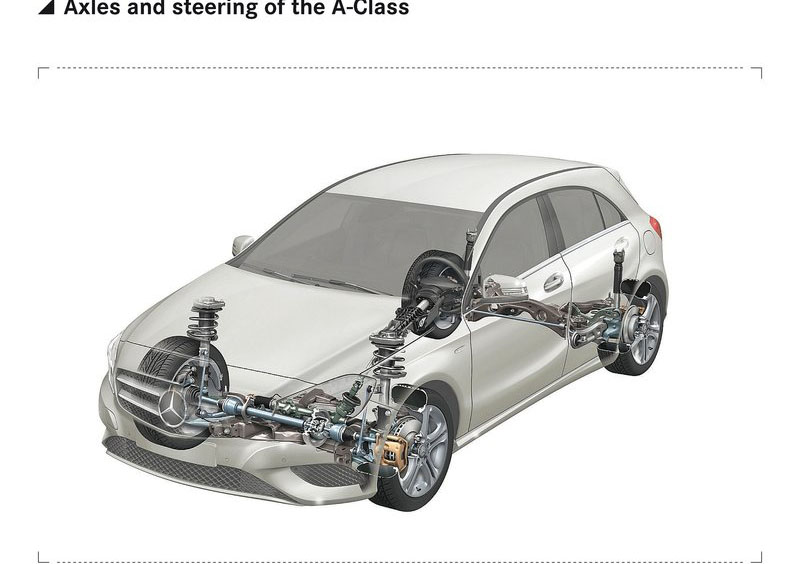
There are three all-independent suspension options which adjust the balance between sportiness and handling to suit the various model packages. All versions have fuel-saving electro-mechanical power-assisted steering, powerful all-round disc brakes incorporating the Mercedes-Benz Hold function, an electronic parking brake and the latest driver assistance systems.
Chassis
The sandwich-floor body construction of the previous two generations of A-Class, which placed the engine partly in front of and partly beneath a twin-floor passenger cell, has been replaced by a sophisticated steel monocoque in the latest model. This has not only brought about a significant reduction in the car's overall height, which has been reduced by 160 mm, and seating positions, which are 174 mm lower, but it has lowered the centre of gravity by 24 mm - an ideal starting point for a car engineered to deliver more dynamic and agile handling.
This is underscored by the structural design of the body-in-white, which features 67 per cent high-strength or ultra-high-strength steels. This increases the rigidity of the chassis from a dynamic behaviour perspective and ensures the new A-Class more than meets the stringent Mercedes-Benz safety standards, which far exceed anything demanded by legislation anywhere in the world.
There is a new bulkhead and floor, an integral support frame as a deformation element, a length of 435 mm over which to dissipate crash energy and load distribution over several planes. Altogether, three longitudinal planes allow impact energy to be absorbed in a controlled manner.
The support frame is the attachment point for the front axle and steering assembly as well as the torque support for the transversely mounted engine and gearbox. It is made up of several steel plates and a hydroformed tube, and is connected by two aluminium struts to the aluminium radiator mount.
A plastic crash wedge at the rear of each front wheel arch prevents the wheel from sliding beneath the door in an impact, thus ensuring that the doors are still capable of being opened after an impact.
Mercedes-Benz has developed what it calls 'skate runners' to discharge frontal impact forces into the floor, which features four straight longitudinal members. To protect the passenger cell in a side impact there are rigid structures which include a pole support fitted diagonally between the central tunnel and the floor sidewalls. This is intended to prevent the floor being torn open even in a side impact with a tree.
High-strength steels in the upper part of the B-pillar minimise intrusion, but the lower part of the pillar is made from softer steels so that crash energy is dissipated in a controlled manner. The B-pillars also house something referred to by Mercedes-Benz engineers as 'vampire's teeth' - small tooth-like recesses which prevent the seat-belt retractor from causing cracks that might affect the body's structural integrity in a crash.
Suspension
The new A-Class has all-independent suspension with three different levels of tuning to strike the ideal balance between comfort and sportiness according to the model variant. Suspension engineers made extensive use of the driving simulators at the Mercedes-Benz development centre in Sindelfingen, compiling a digital profile of the car's dynamic responses as part of the development process before a single prototype was built.
All three suspension arrangements rely on a redesigned MacPherson strut system at the front and a new four-link rear axle developed for the new Mercedes-Benz family of compact front-wheel-drive cars. This, combined with the lower centre of gravity of the latest Mercedes-Benz A-Class, provides a perfect platform for excellent dynamic behaviour.
The four-link rear axle is configured so that forces are absorbed by three control arms and one trailing arm per wheel. This means that longitudinal and lateral influences on the suspension are absorbed virtually independent of each another. The wheel carriers and spring links are made of aluminium to reduce unsprung weight. The goal was to achieve high lateral agility with high straight-line stability and the minimum of slip on the rear axle.
All three suspension configurations deliver exemplary levels of comfort with precise, agile responses, low degrees of roll and low start-off pitch. The A-Class has been set up introduce mild understeer at higher degrees of lateral acceleration so that the driver can control changes in direction with low steering input but high steering precision.
Standard comfort suspension is fitted to A 180, SE and Sport models. AMG Sport versions have the Dynamic Handling Package (optional on Sport), which lowers the ride height by 15 mm and introduces firmer springs and dampers plus AMG multi-spoke 18-inch alloy wheels. Direct-Steer is also part of the Dynamic Handling Package, adding an extra element of agility and precision. Engineered by AMG models feature modified AMG sports suspension.
The latest ESP® Electronic Stability Programme includes Torque Vectoring Brake, which helps to control any tendency towards oversteer in fast cornering by applying slight brake pressure to the outer rear wheel. It has been designed to intervene gently so that skilled and experienced drivers can extract maximum enjoyment out of the car without ever reaching a potentially critical situation.
Steering
The new A-Class features redesigned electro-mechanical steering, engineered to give drivers maximum enjoyment by delivering fast, accurate responses while saving fuel by drawing power assistance from the engine only when the car is turning. A turning circle of just 11 metres adds to the practicality, especially in urban driving conditions, of the A-Class.
The electric motor, which provides servo assistance, is mounted directly on the steering gear. The steering permits various assistance functions in conjunction with the ESP® control unit. For example, it can compensate for the effect of crosswinds and cambered roads, counter the torque-steer effect found in some front-wheel-drive cars, keep the car straight when braking on surfaces where the levels of grip differ from left to right, and counter-steer should the car nudge towards oversteer.
It also makes the optional Active Park Assist with Parktronic. Active Park Assist with Parktronic measures potential parking spaces through two ultrasonic sensors on the front bumper. If the space is large enough for the car, the system operates the electro-mechanical power steering while the driver works the accelerator and brake.
AMG Sport and Engineered by AMG versions of the A-Class come as standard with Mercedes-Benz' Direct-Steer system, which provides variable hydraulic assistance that reduces as speed increases and adds a variable ratio that changes according to the steering angle.
The ratio is indirect when steering straight ahead, thus ensuring exceptional stability, but increases rapidly once a five-degree steering angle has been applied, becoming extremely direct from a steering angle of 100 degrees. As a result, the driver need make only relatively small steering movements when manoeuvring in confined areas or through a series of tight corners. The variable ratio is achieved through a steering rack with different teeth profiles.
Brakes
The Mercedes-Benz A-Class comes as standard with powerful all-round disc brakes. The rear calipers and brake boosters are made from aluminium to reduce unsprung weight. The Mercedes-Benz Hold function is also standard - a slightly firmer push of the brake pedal once the car comes to rest ensures it is held without the driver having to maintain pressure on the pedal. It disengages as soon as the driver touches the accelerator.
Manual versions also have Hill-Start, which momentarily maintains brake pressure while the driver's foot moves from the brake pedal to the accelerator. This ensures the car does not roll backwards when setting off on uphill gradients.
The Hill Start Assist function is incorporated into the standard-fit Adaptive Brake Assist feature, which works in conjunction with the Anti-lock Brakes (ABS) to reduce stopping distances in an emergency. Adaptive Brake Assist is linked to the ASR acceleration skid control and the active yaw control units.
Adaptive Brake Assist comes into operation as soon as the driver abruptly lifts off the accelerator pedal - the first reaction in a potential emergency. It recognises the urgency of the situation and primes the brake pads so that they come into light contact with the brake discs. If emergency braking proves to be necessary, pressure can therefore be achieved instantly. During wet weather the system dries the brake discs by maintaining gentle but imperceptible pressure between brake pads and discs.
An electronic parking brake is standard on all models, helping to free more storage space between the front seats. In models fitted with the 7G-DCT transmission it releases automatically as the car moves away so long as the driver's seat belt is fastened. If activated at speeds of more than 2 mph it also serves as an emergency brake through the ESP® system.
Engines and Transmissions
A dynamic new petrol engine, an ultra-economical new turbodiesel and a performance turbodiesel make their debuts in the new A-Class. The new petrol engine is a 2.0-litre development of the 1.6-litre unit first seen in the new B-Class, and perfectly complements the dynamic design and agile handling of the new A-Class. It develops 211 hp and 350 Nm of torque, accelerating the A-Class to 62 mph in 6.6 seconds and on to a top speed of 149 mph.
It powers the A 250 BlueEFFICIENCY AMG Sport and the A 250 BlueEFFICIENCY Engineered by AMG, driving through the Mercedes-Benz 7G-DCT seven-speed double-clutch automatic transmission, which is fitted as standard to both models.
The first new diesel engine is a 1.5-litre unit that develops 109 hp and 260 Nm of torque, but of greater significance is that it allows the new A-Class to attain a combined fuel consumption figure of 74.3 mpg with CO2 emissions as low as 98 g/km. It is available in SE, Sport and AMG Sport versions.
This frugal and clean diesel powerplant is joined by the range-topping new 2,143 cc turbodiesel engine that powers the A 220 CDI BlueEFFICIENCY AMG Sport. This dynamic unit develops 170 hp at 3,400-4,000 rpm and a muscular 350 Nm of torque available from 1,400-3,400 rpm, good for an 8.2 second sprint to 62 mph and a 137 mph top speed.
Only available with the 7G-DCT dual clutch transmission, this lightweight engine returns 64.2 mpg on the combined cycle and posts a CO2 emissions figure of just 115 g/km. These excellent figures illustrate just how advanced this new engine is - compared with the previous generation A 200 CDI, the new A 220 CDI BlueEFFICIENCY is 30 hp and 50 Nm more powerful, yet is 11.9 mpg more economical and 34 g/km cleaner on CO2 emissions.
These three new advanced engines join four further powerplants that made their debut in the new B-Class.
The familiar 1.6-litre 122 hp petrol engine is available in standard, SE and Sport versions of the A 180 BlueEFFICIENCY and a 156 hp version of the same engine is offered in the A 200 BlueEFFICIENCY Sport and AMG Sport. All except the standard A 180 BlueEFFICIENCY are available with the sophisticated 7G-DCT transmission as an alternative to the standard six-speed manual.
The highly economical 1.8-litre diesel unit develops 109 hp and 250 Nm of torque in the A 180 CDI BlueEFFICIENCY SE, Sport and AMG Sport models - available with the 7G-DCT transmission. A 136 hp version of the same engine also powers the A 200 CDI BlueEFFICIENCY Sport and AMG Sport. This most powerful diesel engine derivative is available with manual or 7G-DCT transmission.
The petrol engines
The all-aluminium M 270 turbo-charged direct-injection engine makes its debut in the new A-Class. This 1,991 cc unit develops 211 hp at 5,500 rpm and 350 Nm of torque from 1,200-4,000 rpm, and is the perfect match for the engaging design and dynamic handling of the new Mercedes-Benz A-Class.
All three M 270 engines are 16-valve four-cylinder units with twin overhead camshafts. They are extremely versatile engines, which are already being phased into larger Mercedes-Benz models to successfully lower fuel consumption, emissions and production costs. Their versatility is exceptional - they can be installed both transversely (M 270) or longitudinally (M 274), combined with front, rear or 4MATIC all-wheel drive, and paired with manual, automatic torque converter or 7G-DCT dual clutch transmissions.
They employ technology first introduced in 2010 with the ultra-modern BlueDIRECT V6 and V8 engines for the Mercedes-Benz S-Class. The combustion process is based on third-generation Mercedes-Benz direct-injection with highly precise, multiple piezo-injection technology. Mercedes-Benz is a pioneer in this field - in 2006 Mercedes-Benz was the first car manufacturer to introduce direct-injection with spray-guided combustion into series production.
Newly developed piezo-injectors allow up to five injections per power stroke. In the warm-up phase this enables particulate emissions to be reduced by more than 90 per cent. The overall result is that all emission figures, including particulates, already surpass Euro 6 emissions standards not due to be enforced until 2015.
Piezo-injectors have numerous advantages in petrol engines compared with conventional multi-hole solenoid valves. The fuel vaporises up to four times as fast, the jet of fuel penetrates less deeply into the combustion chamber, and the injectors are able to deliver minute quantities of fuel with exceptional precision. This prevents fuel from being deposited on the combustion chamber walls, resulting in significantly reduced particulate emissions.
An electrical charge is applied to the piezo-ceramic injectors, which changes their structure in microseconds, and with a precision of just a few thousandths of a millimetre. The central component of a piezo-electric injector is the piezo-stack, which directly controls the metering needle. With a response time of just 0.1 milliseconds, the injection of fuel can be sensitively and precisely adjusted to the current load and engine speed, reducing emissions, fuel consumption and combustion noise.
The third-generation direct-injection system also features rapid multi-spark ignition (MSI). Following the first spark and a brief combustion period, the coil is recharged rapidly and there is a further spark. The MSI system enables up to four sparks within one millisecond. MSI can vary both the timing of the sparks and the combustion period to suit the current operating point. This provides scope for the best possible combustion, which further reduces fuel consumption. Fuel savings of up to 4 per cent alone are possible by the use of piezo-electric injection technology combined with MSI.
Mercedes-Benz has developed an innovation known as CAMTRONIC for its 1.6-litre engine. CAMTRONIC is a load management system which controls intake cut-off and intake valve lift adjustment, and is a first in a turbo-charged direct-injection petrol engine. It reduces throttling losses under partial load, lowering fuel consumption by three to four per cent. In day-to-day driving, which typically has a high proportion of partial load operation, the potential saving is even greater, with fuel savings of up to 10 per cent. It was developed completely in-house by the Mercedes-Benz Technology Centre in Stuttgart and the Daimler engine plant in Berlin.
The high specific outputs of the small-capacity M 270 engines are the result of turbo-charging, which forces intake air into the combustion chambers at a pressure of up to 1.9 bar, with the turbine vanes rotating at up to 230,000 rpm.
The turbo-charger has been designed to deliver high torque even at low engine speeds. It is integrated into a newly developed manifold turbo-charger module, positioned in front of the engine for the best possible cooling. Separate exhaust ducting from the cylinders to the turbo-charger and a high exhaust temperature of up to 1,050 degrees Celsius make maximum use of the exhaust gas energy, producing a high output and outstanding responsiveness.
By using a combination of direct-injection and variable adjustment of the intake and exhaust camshafts, the engines are also able to exploit the advantages of so-called scavenging. This involves a partial overlap of the opening times of the intake and exhaust valves, causing some of the cold intake air to flush the hot exhaust gas from the cylinder into the exhaust manifold, which considerably improves charging.
At low engine speeds the turbo-charger also responds much more rapidly, significantly reducing turbo-lag when moving off. The direct-injection system ensures that the fresh gas is not yet mixed with fuel when it enters the cylinder, as would be the case in engines with manifold injection. No unburned fuel is therefore flushed into the exhaust manifold.
As a result, the 1.6-litre engine in the A-Class delivers its 200 Nm maximum torque at 1,250 rpm, maintaining that twist action through to 4,000 rpm. The 2.0-litre version posts even better results - its maximum torque of 350 Nm is available from 1,250 rpm through to 4,000 rpm, which means that it leads the field for four-cylinder engines.
A new thermal management system has also been developed for these powerplants. In cold state, a switchable water pump with flow-optimised ball valve ensures that no coolant flows through the engine, allowing the combustion chambers to heat up quickly. The thermostat is electronically controlled and the coolant temperatures are adjusted according to driving style and ambient conditions.
The variable vane oil pump operates with two pressure stages. At low engine speeds and loads the pump runs at a pressure of 2.0 bar and the oil-spray nozzles for piston cooling are switched off. The high-pressure stage is activated at higher loads and engine speeds. As a result, the lubrication and cooling of the engine requires significantly lower drive energy than with an uncontrolled pump.
The coolant ducting in the cylinder head is also new. The water mantle is a two-piece construction to improve flow. This leads to specific increases in flow speeds and heat dissipation at certain points, accompanied by a reduction in pressure losses throughout the coolant circuit. This has made it possible to reduce the power output of the water pump despite an increase in engine output.
As it warms up, the flow of coolant is regulated by a triple-phase thermal management system so that it rapidly reaches normal operating temperature. Initially the coolant remains at rest in the engine. It then circulates in the engine circuit, but bypasses the radiator. When a temperature of 105° Celsius has been reached the radiator is included in the circuit.
To ensure absolute smoothness at all times, there are two Lanchester balancer shafts in the bottom of the 2.0-litre engine block to counter the secondary inertia forces inherent in four-cylinder in-line engines. Mercedes-Benz is the first car manufacturer to use anti-friction bearings to balance these masses.
This is achieved via cylinder roller bearings, with axial forces from the gearing taken up by a ball bearing. This arrangement not only improves smoothness, but also helps to lower fuel consumption by reducing friction. Because of its more favourable connecting rod configuration, the 1.6-litre engine does not need Lanchester shafts.
Friction is also minimised by a reduction in flow through the oil and water pumps, low-friction pistons, piston rings and cylinder walls, plus the new thermal management system and chain drive.
The engine and transmission are mounted at four points - by an engine mounting, a transmission mounting and two pendulum supports. These are specially configured for the needs of the high-torque engines to minimise noise. The hydraulic damping integrated into the transmission mounting also contributes significantly to driving comfort.