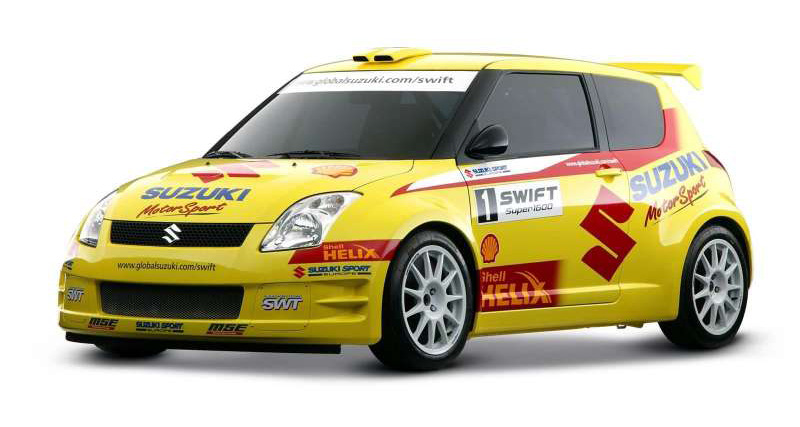
Suzuki Swift, 2005
1. Introduction
A new kind of compact car. A new philosophy and a new beginning.
The 2005 Geneva Motor Show presents the ideal opportunity to introduce both our new Swift compact, as well as our fresh new brand philosophy, which we've chosen to call 'Way of Life!' Like all our products, the Swift has been designed to deliver a driving experience with genuine worldwide appeal.
The new Swift embodies a globally-oriented approach to product development and manufacture. From the very beginning of its development programme, a dedicated team of Suzuki designers and engineers collaborated closely with European automotive professionals and ordinary motoring enthusiasts in pursuit of Suzuki's best compact car ever.
The new Swift is moreeye-catching, morespacious, more refined, more user-friendly, and a whole lot more enjoyable to drive than anything else in the compact-car category. And it gives an exciting glimpse of the new ideas and design approaches that will shape Suzuki models in years to come. As part of Suzuki's global strategy, the Swift will be manufactured in Hungary, Japan, China and India.
Radical innovation: The story behind the new Suzuki Swift
Suzuki recently embarked on a radical new programme of innovation: a mission aimed at reaffirming and strengthening Suzuki's position as a compact-car innovator; a mission destined to yield vehicles embodying the unique DNA of a company that's not only a world leader in compact cars but also the world's dominant force in motorcycles.
The motoring public's first view of Suzuki's new way forward came at the 2002 Paris Motor Show, where Suzuki unveiled the Concept-S, a racy, rally-inspired concept vehicle that reflected influences from Suzuki's two- and four-wheel racing activities and combined the benefits of Suzuki's racing heredity with cutting-edge technological features.
Next to emerge from Suzuki's new programme was the Concept-S2, an open-top sports car in which Suzuki evolved its new-model concept into a form with a more laid-back personality. Unveiled at the 2003 Frankfurt Motor Show, the Concept-S2 was dimensionally similar to the new-generation production vehicle toward which Suzuki was steadily working - a vehicle to be known as the new Suzuki Swift.
The designers' first step was to establish a base in Europe, where they reassessed Suzuki's concept of car design and joined hands with European designers, who gave valuable insight into the European mindset. They stayed in Europe for six months, continuously refining the new Swift's design as they drew inspiration from the European landscape and people. The result is an innovative, sporty, and elegant design that has genuine international appeal.
2. Exterior design
A head-turning fusion of dynamism and stability
Suzuki's exciting new direction in car design is instantly apparent in the exterior styling of the new Swift.
In contrast to the monoform styling adopted for many vehicles in the supermini category, the new Swift has a 1.5-box style that communicates an unmistakable sense of dynamism and substantiality; it consistently earned praise among European motorists who collaborated with the design programme.
A distinctively sporty front face incorporates clear headlamps and a wide airdam that not only suppresses front-end lift but also looks dynamic and stylish. And a stance that conveys a strong sense of stability is created by large-diameter wheels positioned near the extreme corners of the body and by boldly contoured shoulder lines that run from the headlamps to the rear of the body.
A wraparound glasshouse gives the upper half of the new Swift's body a bold, sporty look and helps to imbue the cabin with an appearance of solidity. The wraparound glasshouse design is complemented by a black finish on the A- and B-pillars for an even smarter, more integrated look.
At the sides of the new Swift, clearly defined shoulder lines are complemented by boldly flared wheel arches and side sills that further emphasize the car's strength and stability. The shoulder lines flow toward rear combination lamps that curve forward to meet them above the rear wheels, creating a uniquely solid, sporty, and well-integrated look.
And at the very rear, a substantial-looking, expressively styled tailgate meets a large, wide rear bumper that forms a solid visual base for the lower part of the body. At the top of the tailgate, the roof's trailing edge is shaped as a spoiler - a design that not only looks sporty and enhances aerodynamic performance but also realizes a valuable 1kg weight saving over a conventional bolt-on plastic spoiler.
3. Interior design
A cockpit designed for true driving pleasure
Inside the new Swift, the driver enjoys an environment that reflects a focus on style, sportiness, and driving pleasure.
The wraparound look of the glass surfaces is continued in the cabin design, creating not only a chic look but also a feeling of involvement with the car and confidence in it. Sporty features including a three-spoke steering wheel, a spherical shift knob, and an illuminated ring around the speedometer make driving even more enjoyable.
The top of the instrument panel is positioned optimally low to give the driver a clear view forward. This means the driver enjoys a feeling of openness and finds the new Swift easy to place accurately on the road. The overall result is confident, enjoyable driving with a satisfying feeling of involvement.
Instrumentation that promotes easy, enjoyable driving includes a sporty, easy-to-read triple-gauge instrument cluster in which the tachometer dial, in a reflection of sportbike design, has its mark positioned at six o'clock, where the eye falls naturally. It also includes a centrally located information display that shows the time, fuel consumption, and outside temperature.
The audio and climate-control systems are easy to operate thanks to optimally large, dial-type controls. For added convenience, the audio system can also be operated using optional steering-wheel-mounted controls.
4. Powertrain
Efficient, enjoyable performance for every driving situation
For efficient, enjoyable performance that meets every driver's needs, the new Swift comes with a choice of three comprehensively upgraded engines (the 1.3-litre M13A petrol engine, the 1.5-litre M15A petrol engine, and the 1.3-litre DDiS diesel engine) and with choice of transmissions (a five-speed manual, a five-speed Manual Transmission Automated, and a four-speed automatic).
Each engine is tuned with an emphasis on performance at low and mid-range speeds (crucial in urban driving situations and on winding country roads) and incorporates a range of advanced technologies.
Key technologies of the petrol engines include variable valve timing (used with the 1.5-litre petrol engine), which helps to maximize torque and power throughout the rev range.
The 1.3-litre diesel engine has a common-rail fuel-injection system for superior performance, emission control, and fuel efficiency. It breathes through an intercooled turbocharger, which helps to realize a strong, flat torque curve with smooth response even at low engine speeds.
The transmissions also reflect Suzuki's focus on driving pleasure. Key features are as follows:
The five-speed manual transmission (used with both petrol engines and DDiS) has an updated short-stroke design with comprehensively enhanced shift linkages that give a firm, quick shift feel.
And the five-speed Manual Transmission Automated (used with the 1.3-litre petrol engine) offers the merits of both automated shifting and manual shifting for easy, fuel-efficient driving. Its automated mode has two driver-selectable settings: Economy mode, which emphasizes fuel economy, and normal mode, which emphasizes drivability.
The four-speed automatic transmission (used with the 1.5-litre petrol engine) has a gated shift lever that allows the driver to enjoy shifting gears for added exhilaration. This feature is common among sports saloons and coupes but has rarely been seen in the supermini category.
5. Chassis
Newly conceived systems for next-generation ride and handling
With the new Swift, Suzuki's chassis engineers targeted a dynamic driving experience together with a ride that feels sophisticated and comfortable. They achieved this difficult balance by integrating the body with a newly developed platform incorporating specially conceived chassis systems.
The newly developed platform provides the new Swift with wide treads (front: 1470mm, rear: 1480mm), a great overall width (1,690mm), and a long wheelbase (2,380mm). These dimensions not only benefit interior spaciousness but also help to enable superior on-road stability and comfort.
The front suspension has a new design in which the lower arms, steering gearbox, and rear engine mounting are attached to a suspension subframe. This design gives significantly higher mounting rigidity, which translates into lower road noise and a stronger feeling of stability.
The new Swift breaks further new ground by being equipped with torsion-beam rear suspension, which gives a superior combination of handling stability and ride comfort. One specific merit of the new arrangement is low unsprung weight, which enables camber angle and toe-in to be controlled effectively for accurate and predictable handling. Another merit is a space-efficient layout that permits a low, flat luggage-area floor.
To further enhance the driving experience, the power-assisted steering system has a newly developed steering gearbox that gives a more direct feel. And for further controllability, the braking system has an upgraded design in which increased caliper rigidity and other enhancements give sure stopping power.
6. Safety and security
Class-leading protection from collisions and theft
Peace of mind for users is always a top priority for Suzuki, so the new Swift incorporates the latest technologies for safety and security.
Developing the body from scratch enabled the engineering team to realize an outstandingly crashworthy structure; one in which high-tensile steel and tailored blanks are used extensively to ensure lightness and strength. It also enabled the team to adopt structures (notably in the bonnet, fenders, wipers, and front bumper) that help protect pedestrians in the event of contact.
In the cabin, users are further shielded from impact forces by a collapsible steering column, leg-injury-mitigating brake and clutch pedals, front-seatbelt pretensioners and force limiters, energy-absorbing trim, front airbags, and available side and curtain airbags.
To help ensure that none of the advanced passive-safety technologies is ever needed, the new Swift incorporates a range of active-safety technologies including a four-wheel antilock braking system, an electronic brake-force distribution system, and a brake-assist function, which together help the driver avoid hazards.
7. Utility
Cleverly arranged space for daily convenience
Though the new Swift has dimensions that make it easy to manage on the road, clever use of interior space realizes exceptional people- and luggage-carrying flexibility.
With all seats in use, the luggage area has a generous capacity of 213L (VDA). The luggage area is tall enough to allow a large suitcase to be loaded vertically. Plus, the luggage-area floor is smooth and flat thanks the newly adopted torsion-beam rear suspension.
In higher grades, the rear seat has a 40/60-split design and a tumble-folding function so it can be configured to create an extended, flat luggage surface on each side. Lower grades have a bench-type rear seat with a single-folding seatback that can also be used to create more luggage space. The tailgate can be unlocked electrically at the push of a button, making loading easier when the user's hands are full of luggage.
For further convenience, storage spaces for small, personal items are located around the cabin. They include a compartment in the instrument panel, a glove box, front and rear bottle holders, a seatback pocket, front door pockets (large enough for A4-size road atlases), and a tray under the front passenger seat.
8. Colours
A wide range of stylish body colours
The new Swift is available in 11 stylish body colours. Ten of the body colours were newly developed using environment-friendly water-based paint. Each body colour is a perfect complement for the new Swift's eye-catching contours and proportions.
9. An exciting worldwide promotion
The TVCF uses young world-class footballer Cristiano Ronaldo to promote the all-new Suzuki Swift's agile handling and dynamic performance. The TVCF features the Swift's agile handling as it chases a football through the city streets. Displaying the fine-tuned footwork of a world-class footballer, the nimble Swift is a world-class performer as well.
When the Swift finally comes to a halt, Cristiano Ronaldo himself steps out of the car to the great amusement of a group of kids, leading into the key phrase, 'Wanna Play?'
The all-new Suzuki Swift's performance is squarely aimed at exciting the hearts of everyone. Utilizing this thrilling promotion on a global basis will broaden the appeal of this dynamic compact car around the world.